You bought a turntable. Then you bought 20 records. Then 50. Now you have 150 and they are stacked on the floor next to a stand that was only meant to hold the turntable and maybe a receiver.
Sound familiar? The storage question sneaks up on every vinyl collector, and it usually hits right around the point where the collection outgrows whatever furniture you started with.
This guide is about figuring out what you actually need before you buy, so you do not end up replacing your stand a second time.
How Much Storage Do You Actually Need?
Start with the math, because most people underestimate this.
A standard 12-inch vinyl record in its sleeve is roughly half an inch thick. Some gatefold sleeves and box sets run closer to three-quarters of an inch. So for every 12 inches of horizontal shelf space, you can fit about 20 to 25 records comfortably without cramming them together.
Here is how that scales:
- Casual listener (25 to 50 records): One shelf section, roughly 15 to 24 inches wide. Most entry-level stands cover this.
- Growing collection (50 to 150 records): Two shelf sections or one wide compartment. You want at least 36 inches of total shelf width across all storage areas.
- Serious collector (150 to 300+ records): Multiple compartments, or a larger console-style stand. Figure 60+ inches of combined storage width. Weight becomes a real consideration here.
The part people forget: plan for where you will be in two years, not where you are now. If you have 40 records and you are buying 3 to 5 per month, you will double your collection inside a year. The stand that fits your current 40 records perfectly will feel cramped by next summer.
Weight: The Number Nobody Checks
Vinyl is heavy. One record weighs about 5 to 7 ounces. That does not sound like much until you multiply it.
100 records = roughly 35 to 40 pounds. Add a turntable (15 to 25 lbs), a preamp or receiver (10 to 20 lbs), and you are asking a piece of furniture to hold 60 to 85 pounds. With a larger collection of 200+ records, you are pushing past 100 pounds on the shelves alone.
Cheap furniture made from particle board or thin MDF starts to sag under this kind of load within months. The shelf bows in the center, the record spines tilt, and eventually you are propping up the middle with a stack of books.
Solid wood handles this without drama. A walnut or maple shelf at three-quarters of an inch thick can carry well over 100 pounds across a 24-inch span without flexing. That is one of the practical reasons solid wood furniture costs more, and one of the practical reasons it lasts longer.
Open Shelves vs Closed Cabinets vs Cubbies
Storage style affects how you interact with your collection every day, not just how it looks.
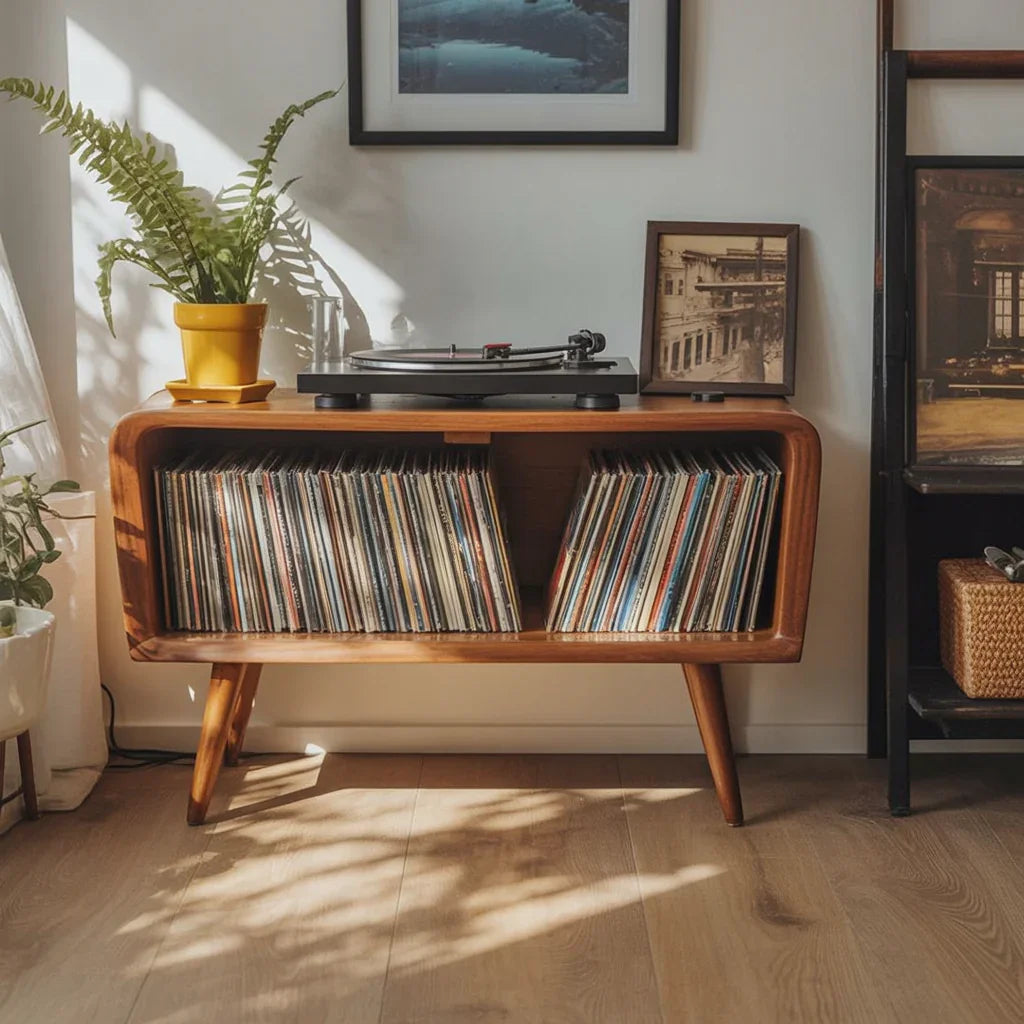
Open shelves let you flip through records easily. You can see the spines at a glance, pull one out without opening a door, and slide it back in. The downside: dust. If you live in a dry climate or near a road, open shelves mean wiping down your records more often.
Closed cabinets keep dust out and give the stand a cleaner look when you are not actively browsing. The trade-off is friction. You have to open the door every time, and if the door opens outward, you need clearance in front of the stand. Some cabinet doors also block airflow to your amp or receiver, which matters if your electronics run warm.
Cubbies (divided compartments) split the difference. Each section holds 20 to 30 records with a built-in divider, so your collection stays organized by genre or artist without you needing separate dividers. No doors to open, but the smaller openings keep dust from settling as fast as fully open shelves.
There is no wrong answer here. It depends on how often you browse, how dusty your space is, and whether you want the records on display or tucked away.
Layout: Where Does the Turntable Sit?
This seems obvious until you start measuring. A standard turntable needs 18 to 21 inches of width and 14 to 16 inches of depth. The dust cover adds another 2 to 3 inches of height when open. If your stand has a shelf directly above the turntable surface, you need at least 8 inches of clearance to open the cover without removing it every time.
The two common layouts:
Top-mount: Turntable sits on the top surface, storage underneath. This is the most popular setup and works well for most rooms. You get easy access to the platter and controls. Just make sure the top surface is deep enough that the turntable does not hang over the back edge.
Mid-shelf: Turntable sits in an open compartment at standing-eye level, with storage above and below. Less common, but useful if you want the turntable at a specific height for ergonomics or if the top surface holds speakers or other gear.
One thing to watch: cable routing. Your turntable connects to a preamp or receiver, which connects to speakers. If everything lives on the same stand, you want a back panel that is either open or has cutouts for cables. A fully enclosed back traps heat and makes cable management a headache.
What Solid Wood Changes
Most record player stands in the $200 to $500 range are made from engineered wood. MDF, particle board, or plywood with a laminate finish. They work fine for light use, but they share a few weaknesses that show up over time.
Laminate chips at the edges. MDF swells if it gets wet (one spilled drink can ruin a shelf). Particle board loses its grip on screws after a few disassemblies. None of these are problems on day one, but they are problems on year two or year five.
Solid wood, especially hardwoods like walnut, maple, oak, or teak, behaves differently. It dents instead of chipping. It handles weight without sagging. It can be sanded and refinished if the surface gets scratched up years later. And it sounds different. Literally. Solid wood dampens vibration better than hollow-core engineered boards, which matters when a turntable stylus is reading grooves at microscopic precision.
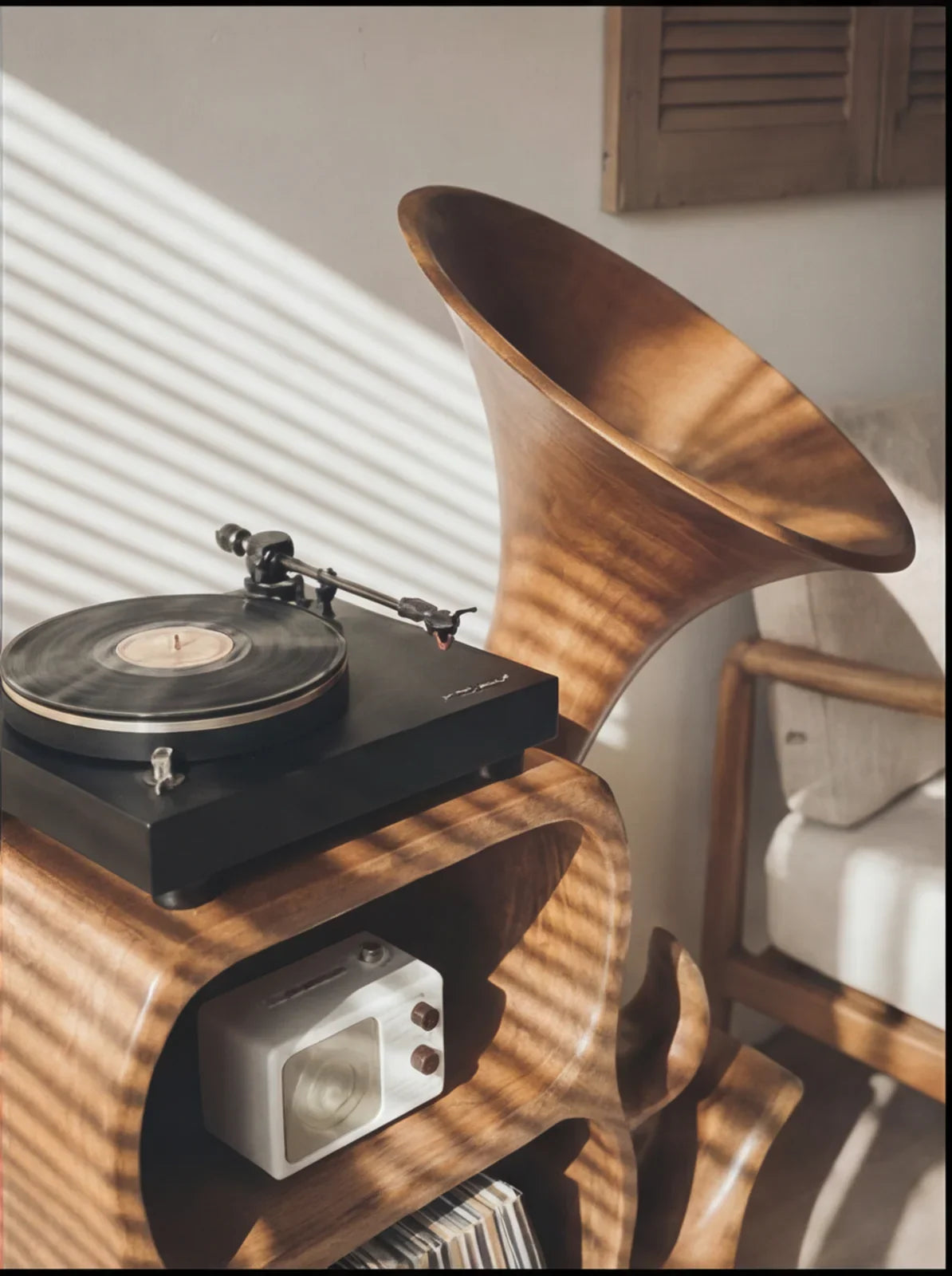
At Ashdeco, the record player stands are built from solid wood by Vietnamese artisans who shape each piece by hand. Live edges, natural grain, organic curves that follow the wood itself. No two pieces look identical because no two slabs of wood are identical. Prices run from about $950 to $3,300 depending on size and wood species.
That is a real investment. But it is furniture you keep, not furniture you replace.
Picks by Collection Size
Here are a few options from the record player stand collection matched to different storage needs.
For 25 to 75 records:
- Mid-Century Modern Record Player Stand ($950 to $1,680). Compact footprint, open front storage, clean mid-century lines. Fits a turntable on top with one wide shelf below for records and a receiver.
For 75 to 150 records:
- Handcrafted Natural Wood Record Player Stand ($1,070 to $1,787). Two storage sections with room for your electronics. The natural wood grain makes each one a one-off piece.
- Farmhouse Turntable Station with Storage ($1,236 to $2,016). Deeper shelves for bigger collections, warmer rustic look.
For 150+ records:
- Solid Wood Record Player Stand, Mid-Century Console ($1,705 to $3,300). The full console option with wide shelving across the entire width. Built for serious collectors who want all their vinyl, gear, and turntable in one place.
- Handmade Wooden Record Player Stand with Vinyl Storage ($1,756 to $2,434). Multiple compartments with extra depth. Handles 200+ records without crowding.
Before You Buy: Quick Checklist
Run through these before making a decision.
- Count your current records. Add 50% for growth over the next 18 months.
- Measure your turntable footprint (width, depth, height with dust cover open).
- Weigh your collection or estimate it (100 records = about 37 lbs).
- Check the stand's shelf weight rating. If it is not listed, ask. If the seller cannot answer, that tells you something.
- Decide on open vs closed storage based on your dust situation and browsing habits.
- Measure your available floor space, including clearance for any doors or drawers.
Ashdeco buyers have given the collection 4.9 stars across 387 reviews, and the most common feedback is about build quality holding up over time. That is exactly what a record player stand needs to do.
Browse the full record player stand collection, or read the DIY vs handcrafted comparison if you are debating whether to build your own.