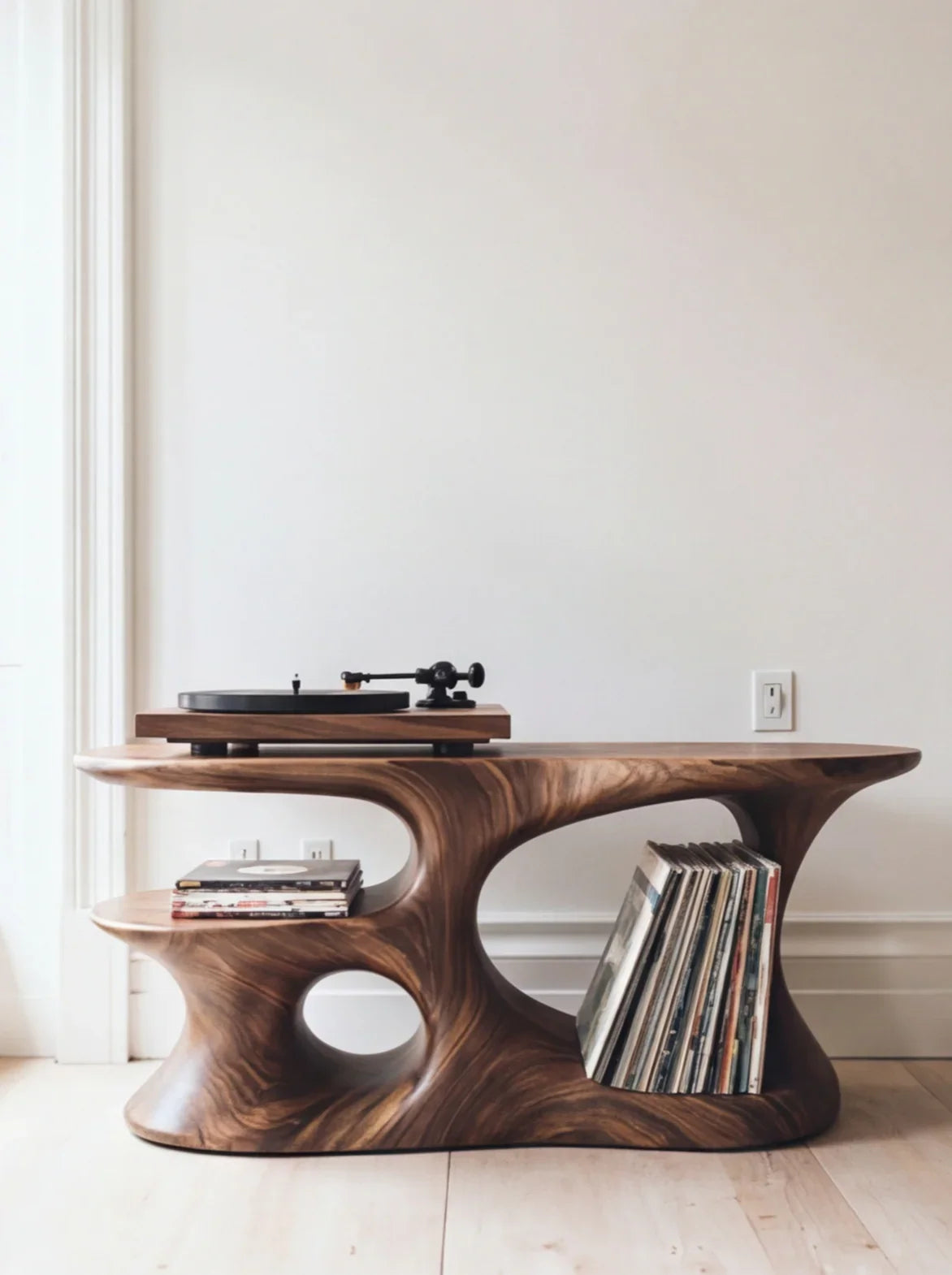
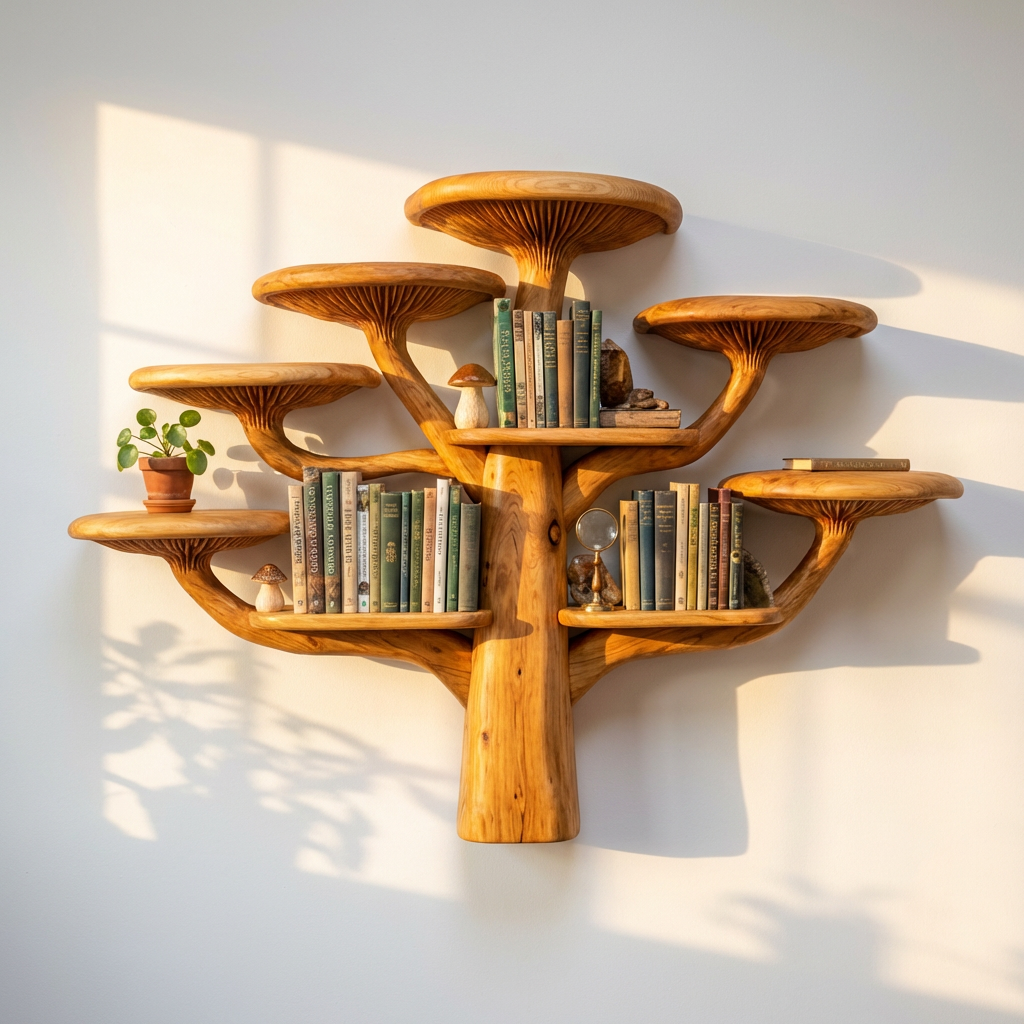
If you are shopping for a mushroom floating shelf, the real decision is usually not color or finish first. It is whether you want a wall-mounted piece or a freestanding one, and whether the carved mushroom details are only decorative or actually well made. A lot of shoppers also see "gill carving" in product titles and do not know if that changes function, price, or durability.
Short answer: a mushroom floating shelf is best when you want sculptural wall decor that saves floor space, while a freestanding mushroom shelf works better when you need more vertical storage and easier repositioning. Gill carving is the carved underside detail that mimics the gills under a real mushroom cap. On a good solid wood piece, it is a craftsmanship detail, not just surface ornament.
Mushroom floating shelf vs freestanding: the quick decision
A mushroom floating shelf is usually the better choice for small rooms, styled walls, and lighter display objects because it keeps the floor clear and acts like wall art that also stores things. A freestanding mushroom shelf makes more sense when you need higher capacity, easier access, and no wall mounting work. The right pick depends on four practical questions: what you are displaying, how much wall drilling you can do, how much floor space you can spare, and whether you want the shelf to read more like decor or furniture.
Here is the simplest comparison.
| Factor | Mushroom floating shelf | Freestanding mushroom shelf |
|---|---|---|
| Floor space used | None | Yes |
| Installation | Requires wall mounting | Usually minimal assembly |
| Best for | Plants, candles, small objects, visual statement | Books, toys, baskets, mixed storage |
| Visual effect | More sculptural, lighter look | More furniture-like, stronger presence |
| Easy to move later | No | Yes |
| Rental friendly | Only if holes are allowed | Better option |
| Weight capacity | Good, but depends on wall support | Often better for heavier loads spread low |
If your goal is to create a focal wall in a bedroom, nursery, powder room, or reading nook, start with the floating shelves collection. If your goal is more bookshelf function with a whimsical look, a tree bookshelf style often gives better day-to-day storage.
What a mushroom floating shelf does better
A mushroom floating shelf wins when the wall itself is part of the design. Because the shelf is mounted off the ground, the carved caps, bark textures, and branch shapes get full visual attention. The room feels less crowded too, which matters a lot in smaller homes.
For example, the Sculpted Mushroom Floating Shelf With Carved Gill Detail starts at $260-$380 and works well when you only need a compact display ledge for candles, crystals, framed art, or a trailing plant.

Floating designs are also easier to style above furniture. You can place one over a console, beside a mirror, above a kid's reading corner, or in a hallway that cannot fit a standing unit. That is where wall-mounted pieces feel smarter than freestanding ones.
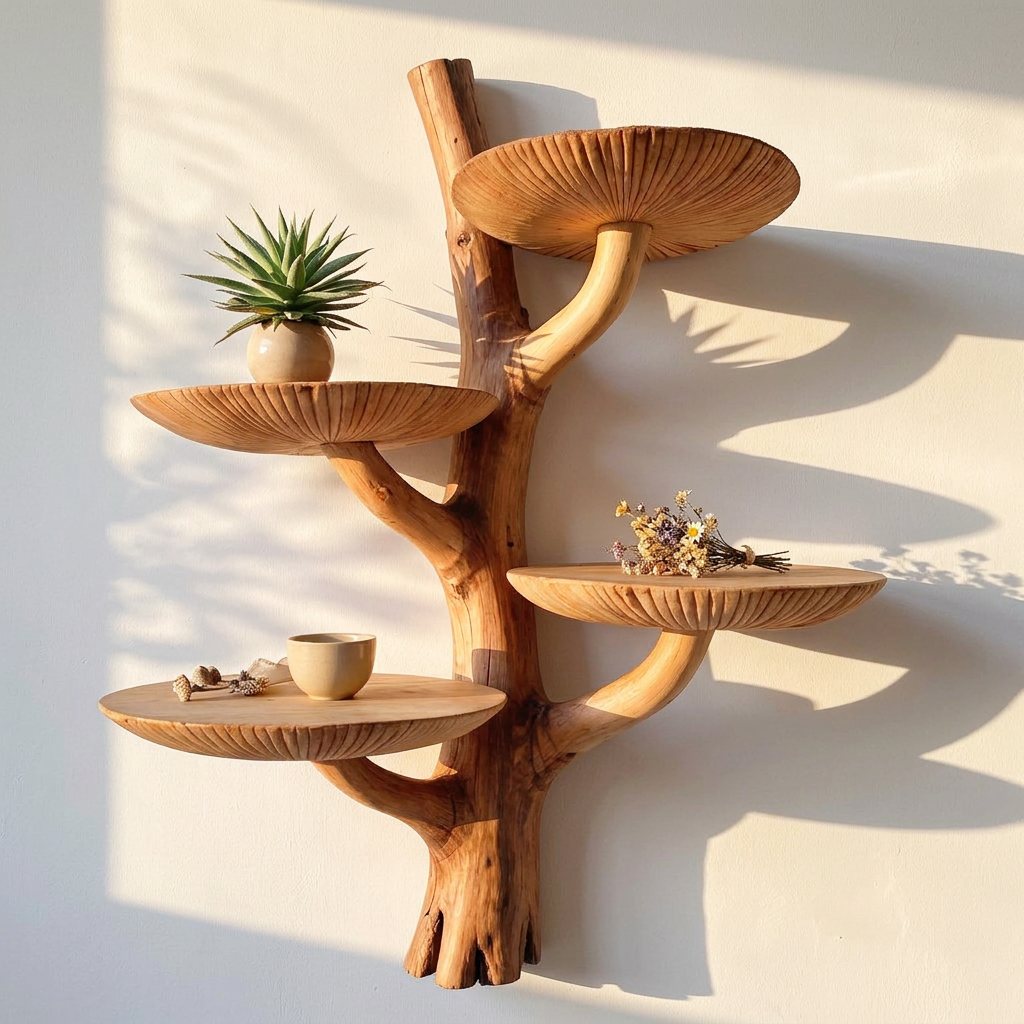
A more dramatic example is the Helical Mushroom Wall Shelf with 4 Graduated Round Platforms, priced at $1,275-$2,450. This one behaves almost like a piece of carved wall sculpture that happens to hold decor.

Helical Mushroom Wall Shelf with 4 Graduated Round Platforms | $1,275-$2,450
Because Ashdeco pieces are handcrafted by Vietnamese artisans, the better mushroom floating shelves do not look stamped out of a mold. The cap edges vary a bit. The carved lines under the cap have hand-worked character. That is the difference between a novelty shelf and one-of-a-kind pieces that read like collectible decor.
When freestanding mushroom shelves make more sense
Freestanding shelves are less delicate to plan around because you are not committing to one wall location. If you restyle your room often, move apartments, or want the shelf to hold books instead of lighter decor, a standing piece is usually easier to live with.
The Standing Mushroom Tower Bookshelf With Tiered Round Shelves starts at $980-$1,880 and gives you more usable storage than a small wall shelf. You can load the lower levels with books or boxes, then keep the upper tiers decorative.

If you want something that fills an empty vertical corner better, the Mushroom Tree Corner Shelf Floor to Ceiling runs $1,535-$3,035 and leans closer to bookshelf territory than accent-shelf territory.

Mushroom Tree Corner Shelf Floor to Ceiling | $1,535-$3,035
That is the main divide. Floating shelves are stronger for visual storytelling on a wall. Freestanding pieces are stronger when storage volume matters and you want flexibility.
What gill carving actually means
Gill carving is the carved underside texture that copies the thin radiating lines you see under a real mushroom cap. On furniture and shelf design, it usually appears on the underside or outer rim of each cap-shaped platform. Good gill carving adds depth, shadow, and realism. Cheap gill carving looks shallow, repetitive, or machine-cut.
On a solid wood mushroom shelf, gill carving matters in four ways.
First, it changes the shelf from cute to sculptural. Without the underside detail, the cap often looks like a plain round tray. Once the artisan carves the underside lines, the mushroom form reads clearly from different angles.
Second, it affects how handmade the piece feels. Gill carving is hard to fake well. The spacing, depth, and edge transitions show whether the maker actually shaped the wood or just cut out circles and stained them.
Third, it can justify part of the price jump. Compare a compact floating shelf at $260-$380 to a larger carved wall piece at $1,180-$2,880 or $1,480-$4,080. A lot of that difference comes from complexity, size, and carving labor, not just wood volume.
Fourth, it changes how the shelf catches light. This matters more than people expect. A plain round shelf looks flat from a distance. Deep gill carving creates shadows that make the mushroom caps pop, especially near a window or wall sconce.
One of the clearest examples is the Oyster Mushroom Tiered Wall Shelf with 4 Wide Caps, priced at $1,480-$4,080. The exposed carving under the caps gives it a layered, almost gallery-piece feel.

Oyster Mushroom Tiered Wall Shelf with 4 Wide Caps | $1,480-$4,080
Which one should you buy for each room
A mushroom floating shelf is usually the right buy for powder rooms, entry corners, reading nooks, above-dresser styling, and small nursery walls. In those spaces, floor area is limited and the shelf is doing visual work as much as storage work.
A freestanding mushroom shelf is usually the right buy for living rooms that need vertical presence, kids' spaces that need reachable storage, and corners where a standard rectangular bookshelf feels too stiff. If you want the function of a bookshelf with more personality, standing designs tend to win.
Here is a room-by-room guide.
| Room | Better choice | Why |
|---|---|---|
| Small bedroom | Floating | Keeps floor open and works above furniture |
| Entryway niche | Floating | Better for narrow walls and decorative impact |
| Nursery wall | Floating or low freestanding | Depends on reach, safety, and wall space |
| Reading nook | Freestanding | Better for books and baskets |
| Living room statement corner | Freestanding | Fills height better |
| Bathroom | Floating | Easier to keep floor clear |
| Rental apartment | Freestanding | Easier move-out and less wall damage |
For nursery and kids' spaces, I would be more selective. The style can be beautiful, but function and reach matter more than novelty. If the goal is actual book access for children, a tree bookshelf often beats a highly sculptural mushroom wall piece. If the goal is soft woodland decor with a few display items, the floating option works well.
If you want corner-specific wall styling, the corner floating shelves collection is also worth pairing with this keyword cluster.
Honest downsides
Mushroom shelves look great in photos, but they are not the simplest storage choice.
The first downside is usable surface area. Round or cap-shaped platforms waste more edge-to-edge space than rectangular shelves. A mushroom cap may look wide, but the functional flat zone is often smaller than you expect.
The second downside is price. Truly sculptural carved solid wood pieces cost more because they take longer to shape. That is especially true on models with deep gill carving, bark texture, layered platforms, or helical forms.
The third downside is styling discipline. Mushroom shelves already carry strong personality. If you overload them with too many decor items, the whole setup can feel cluttered fast.
The fourth downside is wall planning for floating versions. You need the right mounting height, enough stud support, and the discipline to place items thoughtfully. A freestanding piece avoids that, but then you give up floor space.
So no, a mushroom floating shelf is not the universal best shelf. It is the best shelf when you want function plus visual character, and you are willing to trade some raw storage efficiency for that sculptural look.
My recommendation
If you want the cleanest balance of price, wall impact, and easy styling, start with a compact mushroom floating shelf with visible gill carving. It gives you the theme without overwhelming the room.
If you want the strongest artistic statement and have the budget, go for a larger carved wall piece such as the helical or oyster-style designs. These look closer to functional wood sculpture than standard shelving.
If you mainly need storage and only secondarily want the mushroom look, buy a freestanding version. You will get more practical use from it over time.
That is the blunt version. Buy floating for visual impact and space saving. Buy freestanding for flexibility and storage. Treat gill carving as a real craftsmanship signal, especially on handcrafted by Vietnamese artisans pieces where the carving depth and character are visible in the photos.
FAQ
Is a mushroom floating shelf strong enough for books?
Sometimes, but it depends on the design and mounting. Compact mushroom floating shelves are usually better for decor, small planters, candles, and light books. If you want to hold a larger stack of hardcovers, a freestanding mushroom shelf or a dedicated tree bookshelf is the safer choice.
Does gill carving make a shelf more expensive?
Yes, often. Deep visible gill carving takes more shaping time and more finishing work. On handcrafted solid wood pieces, that carving labor is one reason some mushroom shelves jump from a few hundred dollars into the four-figure range.
Are mushroom floating shelves good for a nursery?
They can be, especially for soft woodland styling, framed art, and lightweight decor placed above reach. If the shelf is meant for everyday kid access or actual book storage, a lower bookshelf-style piece is usually more practical than a purely decorative wall shelf.
What is the difference between a mushroom wall shelf and a mushroom bookshelf?
A mushroom wall shelf is mounted to the wall and usually works as accent storage. A mushroom bookshelf is more likely to be freestanding or vertically scaled for books, baskets, and daily use. The wall shelf is more sculptural. The bookshelf is more functional.
Do mushroom shelves work in modern interiors?
Yes, if the rest of the room stays restrained. The best modern pairing is a clean wall, limited color palette, and one strong shelf silhouette. That lets the organic carved form stand out without making the room feel themed.