



Quick view
- Standard Nightstand Size: The Baseline Numbers
- How Big Is a Nightstand for Different Bed Sizes?
- Nightstand Height: The Most Important Dimension

- How Close Should Nightstand Be to Bed?
- Nightstand Depth: The Forgotten Dimension
- Special Nightstand Size Scenarios
- Quick Nightstand Size Calculator
- Frequently Asked Questions
- Bottom Line
Shop this guide
Handcrafted Nightstands, made to order in solid wood.
 Solid Wood Tree Branch Nightstand – Rustic Free Standing Shelf
$1,123.00
Solid Wood Tree Branch Nightstand – Rustic Free Standing Shelf
$1,123.00
 Modern Nightstand Rattan Side End Table with Storage – Solid Wood Legs, Accent Bedside Furniture
$750.00
Modern Nightstand Rattan Side End Table with Storage – Solid Wood Legs, Accent Bedside Furniture
$750.00
 Sculptural Hand-Carved Tree Root Solid Wood Nightstand & 2-Tier Bedside Table
From $1,265.00
Sculptural Hand-Carved Tree Root Solid Wood Nightstand & 2-Tier Bedside Table
From $1,265.00
 Sculptural Handcrafted Stepped Solid Wood Nightstand & Bedside Table with Storage Drawer
From $1,276.00
Sculptural Handcrafted Stepped Solid Wood Nightstand & Bedside Table with Storage Drawer
From $1,276.00
 Modern Curved Solid Wood Nightstand with Drawer & Open Storage Shelf
$1,235.00
Modern Curved Solid Wood Nightstand with Drawer & Open Storage Shelf
$1,235.00
 Rustic Modern Live Edge Nightstand
$1,234.00
Rustic Modern Live Edge Nightstand
$1,234.00
Nightstand Size Guide: Exact Dimensions for Every Bed & Room (2026)
Get the nightstand size wrong, and you'll notice it every single day - reaching too high for your glass of water, bumping your knee in the dark, or watching a lamp overhang a too-small surface. Get it right, and the piece disappears into a perfectly functional bedroom layout.
This guide gives you exact dimensions of nightstand pieces for every bed size, room layout, and use case - plus the placement rules that interior designers follow but rarely publish. (Sizing is only half the decision - once you've got your numbers, our best wood nightstand guide and solid wood nightstand guide cover the material and construction side.)

Standard Nightstand Size: The Baseline Numbers
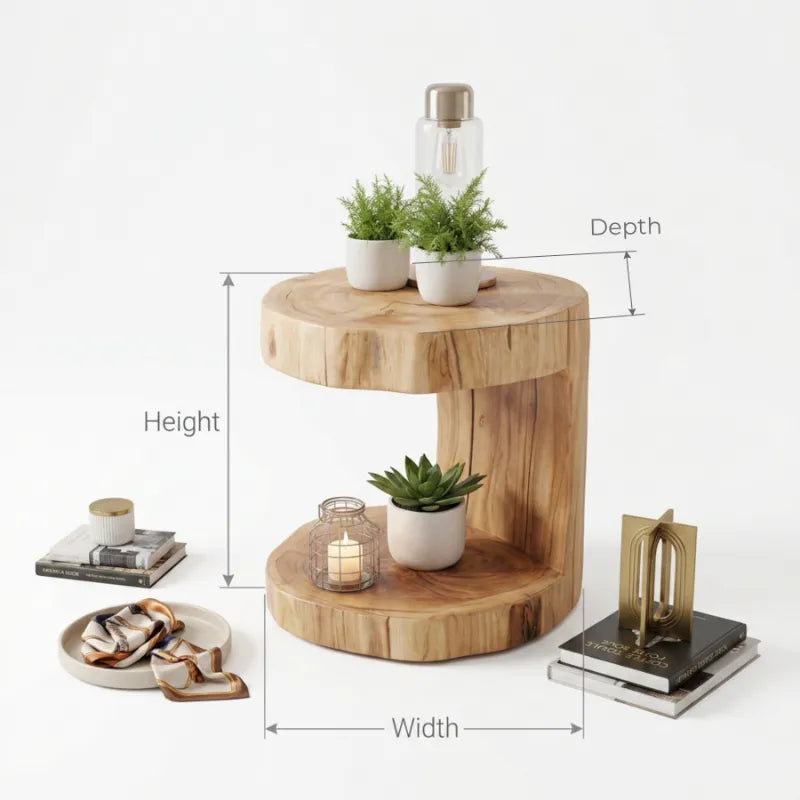
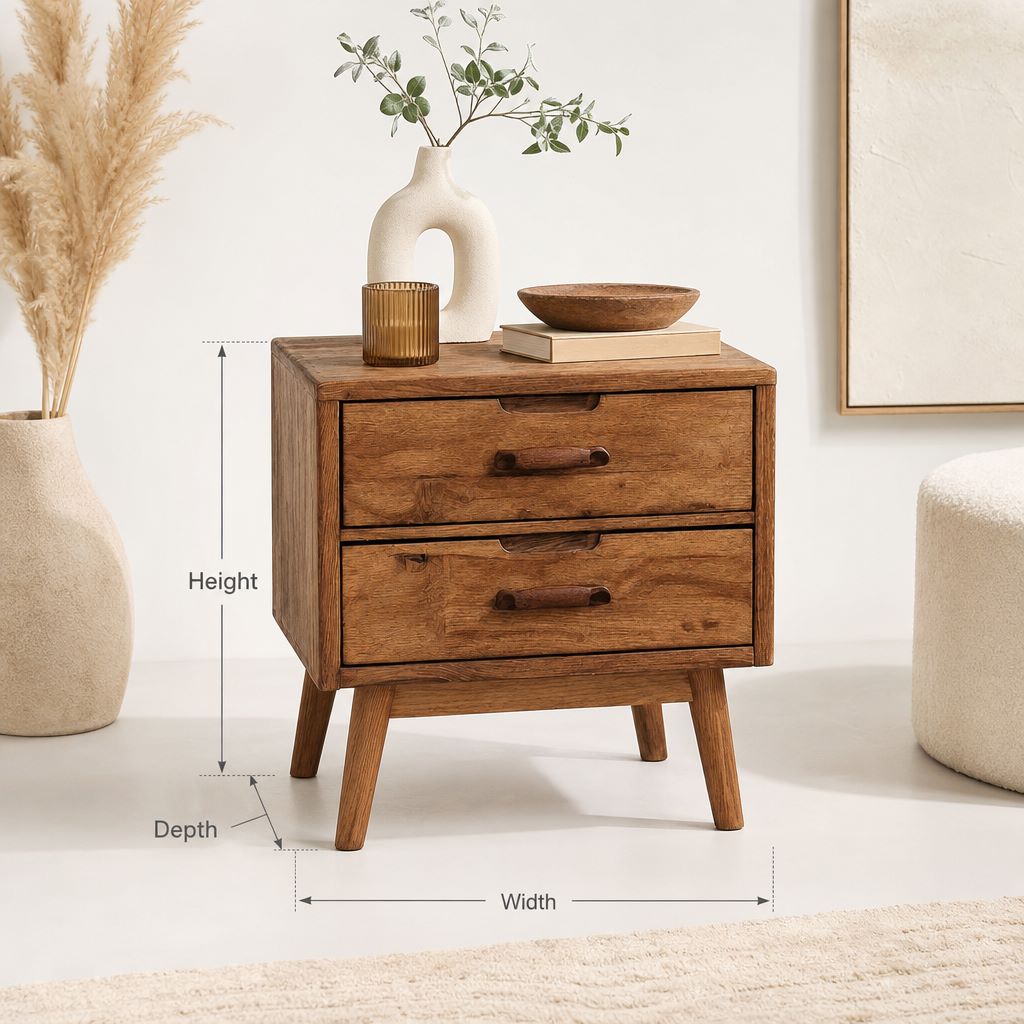
The standard nightstand size across the furniture industry is:
| Dimension | Standard Range | Most Common |
|---|---|---|
| Height | 23"–28" | 24"–26" |
| Width | 21"–28" | 22"–24" |
| Depth | 15"–20" | 16"–18" |
These dimensions work for most queen and king bed setups in rooms with adequate space. But "standard" isn't always right - it depends on your specific bed, room, and habits.
How Big Is a Nightstand for Different Bed Sizes?
Here's the sizing guide most retailers don't provide:
| Bed Size | Nightstand Width | Nightstand Height | Nightstand Depth |
|---|---|---|---|
| Twin (38" × 75") | 14"–20" | 22"–26" | 14"–16" |
| Full (54" × 75") | 18"–24" | 22"–26" | 15"–18" |
| Queen (60" × 80") | 21"–28" | 24"–28" | 16"–18" |
| King (76" × 80") | 24"–32" | 24"–28" | 16"–20" |
| California King (72" × 84") | 24"–30" | 24"–28" | 16"–20" |
The width rule: your nightstand should be roughly 1/3 to 1/2 the width of the mattress on that side. A 32-inch nightstand next to a twin bed looks comically oversized. A 16-inch piece next to a king bed looks lost.



Nightstand Height: The Most Important Dimension
Height matters more than width or depth because it affects every reach, every placement, every interaction. The golden rule:
Your nightstand should be level with the top of your mattress, or 2–4 inches above it.
Why Height Above the Mattress Is Better
- Easier reach from lying down: If the surface is at or above mattress level, you can reach your phone, glasses, or water without lowering your arm awkwardly
- Visual balance: A nightstand shorter than the mattress looks sunken and disproportionate in the room
- Lamp placement: A taller nightstand puts the lamp shade above your eye line when lying in bed, reducing glare
How to Measure
- Measure from floor to the top of your mattress (including mattress pad/topper)
- Add 0–4 inches to that number
- That's your ideal nightstand height range
Example: Floor-to-mattress = 24 inches. Ideal nightstand height = 24"–28".
Special Cases
| Bed Type | Typical Mattress Height | Recommended Nightstand Height |
|---|---|---|
| Standard platform bed | 20"–24" | 22"–26" |
| Bed with box spring | 24"–28" | 24"–28" |
| Low platform / Japanese style | 14"–18" | 16"–22" |
| Adjustable base (raised) | 28"–34" | 28"–32" |
| Bunk bed (top) | N/A | Use wall-mounted shelf or clip-on light instead |
How Close Should Nightstand Be to Bed?
This is the question most guides skip, and it's the one that causes the most daily frustration.
The Ideal Gap: 2"–6"
Leave approximately 2 to 6 inches between the edge of your bed frame and the nightstand. Here's why:
- Too close (0"–1"): The nightstand scrapes against the bed frame when you move the bed to change sheets. It can also cause friction marks on both pieces
- Just right (2"–6"): Close enough to reach everything comfortably, but enough clearance to avoid scraping and to make bed-making easier
- Too far (8"+): You'll have to lean or stretch to reach items on the nightstand from bed - defeating the entire purpose of having one
Measuring the Available Space
Before buying, measure the distance from the bed frame edge to the nearest obstacle (wall, door, closet). Subtract 2–3 inches for the gap on the bed side. The remaining space is your maximum nightstand width.
Example: Bed edge to wall = 20 inches. Subtract 3 inches for gap. Max nightstand width = 17 inches. That means a narrow nightstand, not a standard one. If your room runs tighter than this across the board, our narrow nightstand guide covers space-saving widths and depths in more detail.
What If the Space Is Uneven?
It's common for one side of the bed to have more room than the other (a wall on one side, open space on the other). In that case:
- Use different-width nightstands on each side - this is perfectly acceptable in interior design
- Keep the height the same on both sides for visual consistency
- Match the material or style (both wood, or both with metal accents) even if widths differ

Nightstand Depth: The Forgotten Dimension
Depth (front to back) is rarely discussed but critically important:
- 15"–16" depth: Fits a standard lamp base (4"–5" diameter) plus phone/book with 2"–3" clearance from the edge. Ideal for small rooms
- 17"–18" depth: Comfortable for a larger lamp, lampshade overhang, and multiple items. Standard for most bedrooms
- 19"–20"+ depth: Only needed if you plan to use the nightstand surface as a mini-desk (laptop, writing) or if you have particularly large decor items
A nightstand that's too deep protrudes into the walkway. In a bedroom where the bed-to-door clearance is already tight, a 20-inch-deep nightstand can make the room feel cramped. Stick to 16"–18" unless you have a specific need for more depth.
Special Nightstand Size Scenarios
Platform Beds (No Box Spring)
Platform beds sit lower to the ground - often 14"–20" to the top of the mattress. A standard 25-inch nightstand will tower over the bed. Look for shorter nightstands (18"–22 inches) or add a mattress topper to raise your sleep surface.
Adjustable Bed Bases
When raised, adjustable bases can push the mattress surface to 30"+. You'll need a taller nightstand or riser blocks. Measure the height in your most-used raised position, not flat.
Shared Nightstand Between Two Twin Beds
A single nightstand placed between two twin beds should be 18"–24 inches wide. Each person gets roughly half the surface. Ensure drawers open from both sides (or use a design with no drawers, just open shelves).
Corner Placement
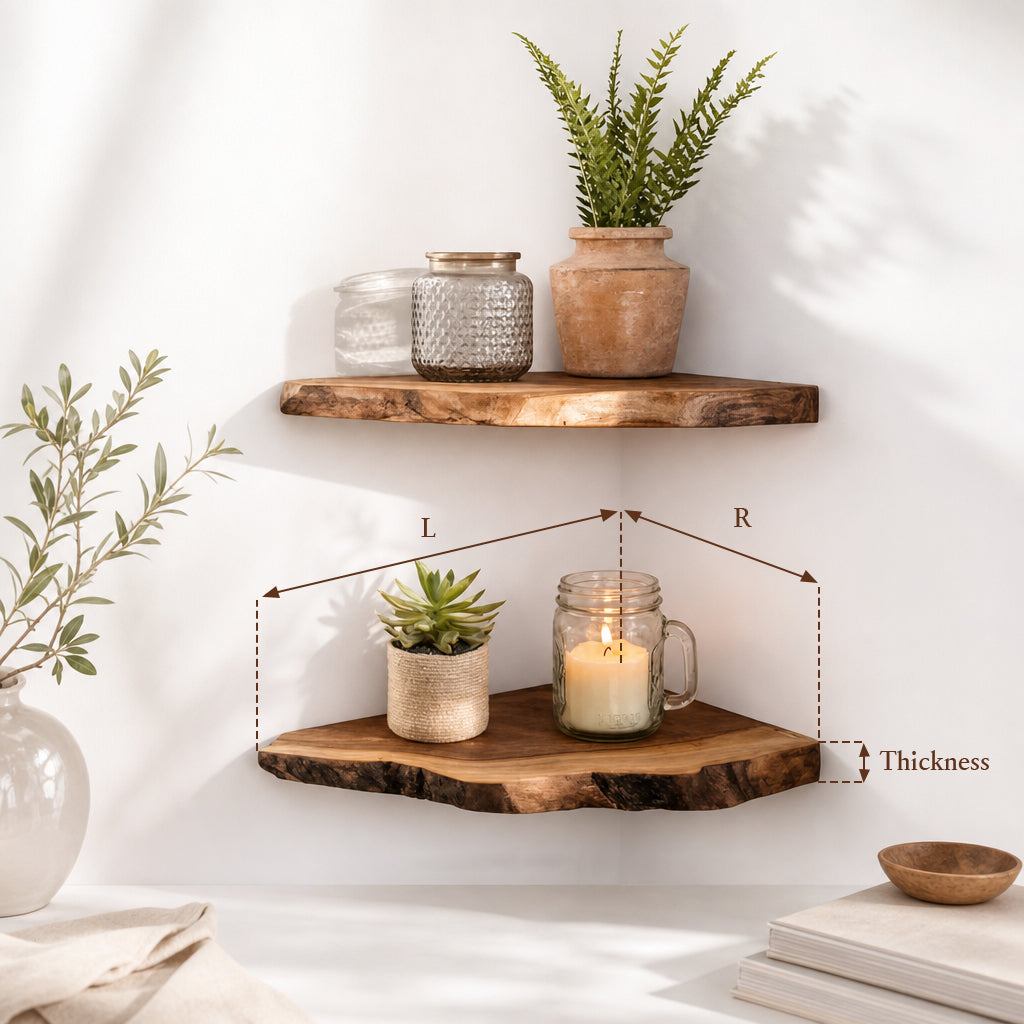
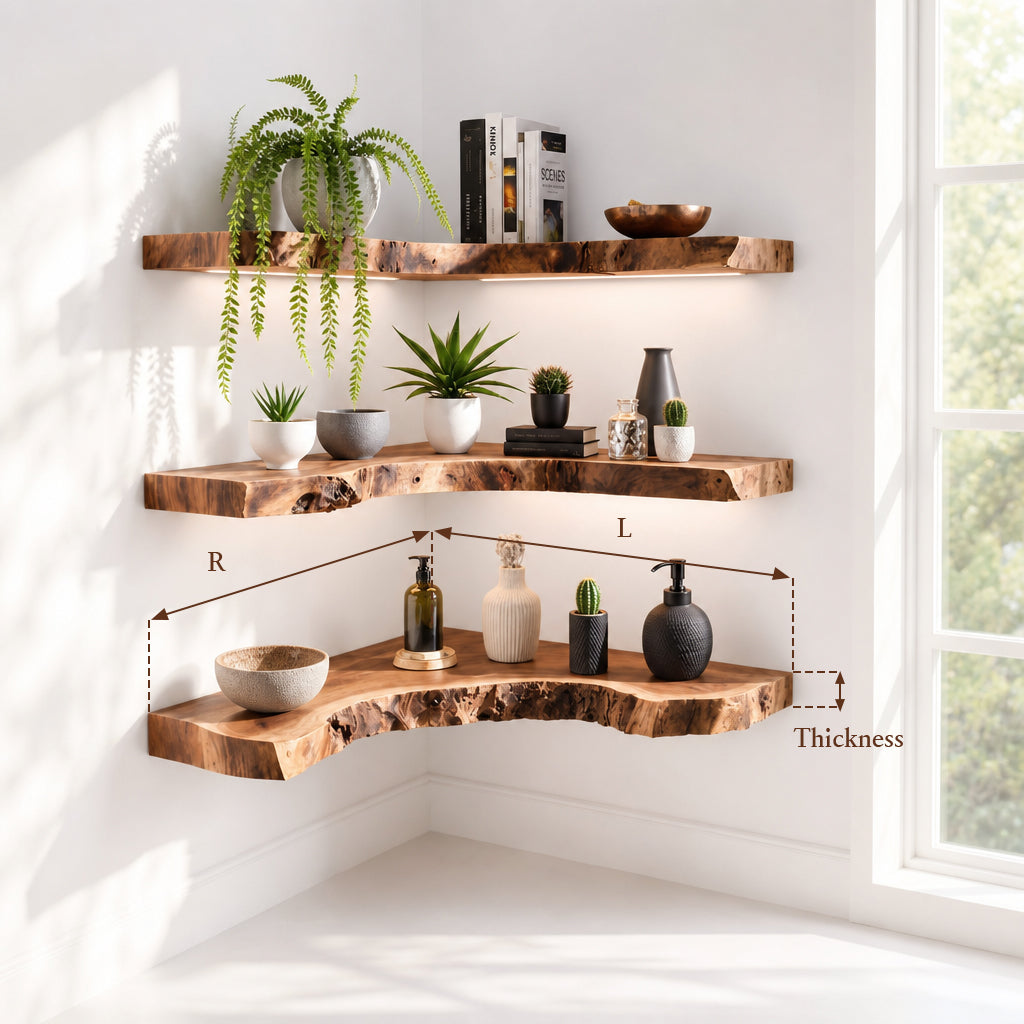
When a nightstand goes in a corner (bed against two walls), a triangular or angled corner nightstand saves space. Otherwise, measure the diagonal clearance - you'll typically lose 3"–5" compared to a straight-wall placement. This is another scenario where a genuinely narrow, corner-friendly piece works better than a standard one - see the narrow nightstand space-saving guide for specific widths that fit tight corners.

Quick Nightstand Size Calculator
Use this simple formula to find your ideal nightstand dimensions:
- Height: Floor-to-mattress height + 0 to 4 inches
- Width: (Bed edge to nearest obstacle) minus 3 inches
- Depth: 16"–18" for most bedrooms; 14"–15" for tight rooms; 19"+ only if needed
Then check: does the width fit the bed-size proportion guide above? If yes, you've got your numbers.
Frequently Asked Questions
How big is a nightstand on average?
The average nightstand is about 24 inches wide, 17 inches deep, and 25 inches tall. But "average" isn't always right for your bedroom - always measure your specific bed and room layout before buying.
Can nightstands be taller than the bed?
Yes, and many designers actually prefer nightstands 2–4 inches taller than the mattress. It makes reaching items easier from a lying position and creates a more intentional, built-in look. Just don't go more than 5 inches above - at that point, it starts to look disproportionate.
How close should a nightstand be to the bed frame?
Leave 2 to 6 inches of space between the bed frame and the nightstand. This gap prevents scraping during bed-making, allows for slight bed movement, and still keeps everything within easy reach from the pillow.
What are standard nightstand size measurements?
Standard nightstand dimensions are 21"–28" wide, 15"–20" deep, and 23"–28" tall. The most common single size sold is approximately 22"W × 16"D × 25"H.
Do all nightstands in a bedroom need to be the same size?
No. If one side of the bed has less space than the other, using different-width nightstands is perfectly fine and often recommended by interior designers. Keep the heights matching and the styles complementary for a cohesive look.
How much space should be between two nightstands on a wall?
If you're placing nightstands along a wall (not flanking a bed), leave at least 36 inches between them for comfortable walking clearance. In tighter rooms, 30 inches is the absolute minimum.
Bottom Line
Once you know your nightstand size - height matched to your mattress, width proportioned to your bed, depth that fits the room - the rest of the decision comes down to material and craftsmanship. Ashdeco's nightstands are handcrafted from solid acacia, walnut, teak, and reclaimed wood by Vietnamese artisans, in widths and profiles that cover everything from tight apartment bedrooms to spacious king setups.
Know your size - now find your nightstand
Browse Ashdeco's handcrafted solid wood nightstand collection, or read up on the right wood species and construction details before you buy.
Shop Nightstands Compare Wood TypesRelated guides: Solid Wood Nightstand: Complete Guide to Wood, Drawers, Size & Quality · Best Wood Nightstand: Oak, Walnut, Maple & More Compared · Narrow Nightstand: Space-Saving Guide for Small Bedrooms