How to Hang a Coat Rack: Studs, Anchors & a Wall That Holds
How to hang a coat rack is a fastening problem, not a styling problem. A wall-mounted rack is only as strong as what is behind the plaster: studs, masonry, or a drywall anchor that will creep the first week of winter coats. This is the install sequence - find the structure, pick the hardware, level the rack, and load-test it before you trust it with a wool overcoat.
This is not the no-drill renter article. If you cannot put screws in the wall, use coat rack for renters or a standing tree. Hook height (60-65 inches, kids' row, ADA) is already in the coat hook height guide. Below is how the rack gets on the wall.
Quick Answer
- Best method: lag or wood screws into at least two wall studs. That is the only install that belongs under a household of coats.
- Drywall anchors: fine for a hat and a light jacket. Not a plan for parkas, backpacks, or a solid wood branch rack.
- Height: 60-65 inches from the floor to the hook for adults. Mark height after you know where the studs are, so you are not choosing between "pretty" and "strong."
- Two-person job for anything over ~20 lbs of wood. One holds level, one drives.
- Load-test: hang your heaviest coat and pull down on it. If the board ticks or the anchor spins, redo it now.
What You Need
- Stud finder (or a magnet + tape measure at 16-inch centers)
- Level
- Tape measure and pencil
- Drill and the bit size your hardware calls for
- 2.5-3 inch wood screws or lags for studs (not the 1-inch screws that come in some kits)
- Toggle bolts or heavy anchors only where a stud is impossible - and even then, treat capacity as light
- For brick or concrete: masonry bit and sleeve anchors rated for shear, not picture hooks
A solid wood wall tree is furniture, not a framed print. Hardware should match that - the same logic that applies to mounting any floating wall piece: the wall connection is the product.

Step 1: Pick the Wall and the Height
Choose the wall people already dump coats on - usually the hinge side of the door, out of the swing. Measure the swing with the door at 90 degrees so the rack never sits in that arc.
Mark a light level line at 60-65 inches for adult hooks. If kids need to reach, plan a second row at 36-42 inches or pick a branch rack with staggered arms rather than dropping the only row so low that adult coats drag.
If you do not yet know how long the rack should be, size it first using the width and height guidance in the coat rack buying guide. Installing a 12-inch plaque for a family of four is a wasted hole.

Step 2: Find Studs (Do This Before You Drill)
US residential studs are usually 16 inches on center. Scan the wall, then confirm: a knock that goes from hollow to solid, or a magnet that catches a screw in the drywall.
You want two studs under a wood rack that will hold real coats. One stud plus a drywall anchor is a pivot. Two studs shares the load.
If the rack's screw holes do not land on studs:
- Shift the rack a few inches left or right (almost always better than forcing the original mark)
- Or add a French cleat / ledger board that does hit two studs, then hang the decorative rack on the cleat
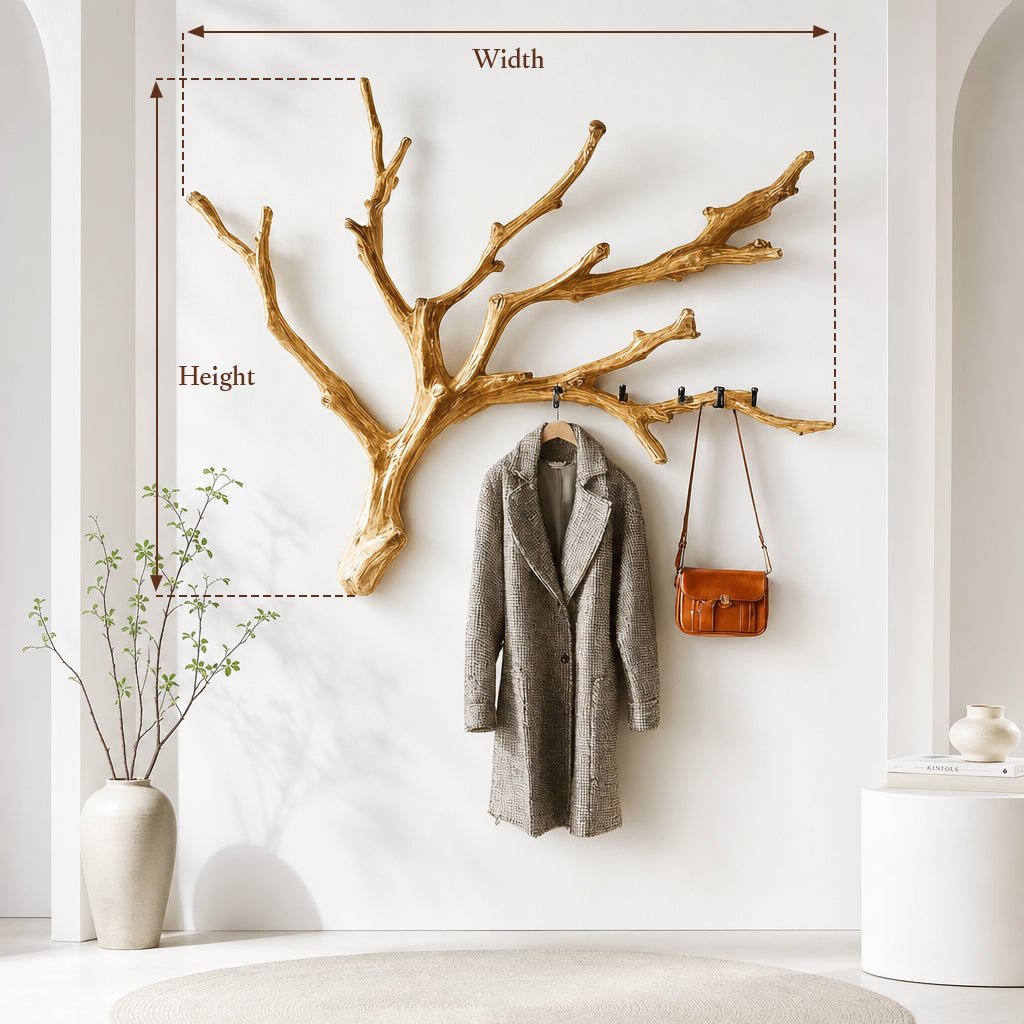
A driftwood or tree-branch piece like Wall-Mounted Driftwood Coat Rack often has irregular mounting points. Do not chase the branch holes into empty drywall. Make the wall structure, then attach the wood.

Step 3: Fasten by Wall Type
Drywall over wood studs (most houses)
- Hold the rack on the level line. Mark through the mounting holes onto the studs.
- Drill pilot holes slightly smaller than the screw shank so you do not split the rack or the stud.
- Drive 2.5-3 inch wood screws through the rack (or through its bracket) into the center of each stud.
- Snug, then stop. Crushing the wood face does not add strength.
This is the install for Custom Wood Coat Rack and Rustic Wall Coat Rack.
Drywall, no usable stud
This is the weak case. Toggles hold more than plastic plugs, and still less than a stud. Use it for light jackets and hats, or pick a standing tree instead. Do not put a winter household on four plastic anchors. That failure mode is why the renter coat rack article exists.
If you care about the wall finish, a clean hole strategy for any floating wall piece is worth reading before you drill - same wall, same caution.
Brick or masonry
Drill into the brick face, not only the mortar, unless the manufacturer specifies mortar-set anchors. Mortar is the soft joint; a heavy rack will walk it. Use a masonry bit, clear dust, set sleeve anchors, and do not overtighten and spall the brick.
Plaster over lath
Studs still exist behind it. Find them. Plaster cracks if you lean on anchors between lath. Pilot slowly; old plaster blows out around a spinning bit.

Step 4: Level, Tighten, Load-Test
- Recheck level after the first screw. The second screw locks any mistake.
- Tighten until the rack does not rock. A branch rack can look crooked and still be level at the mounts - trust the level, not the branch tips.
- Hang the heaviest coat you own on the outermost hook (longest lever). Pull down. Watch the wall, not the coat.
- If you hear drywall crush or see the head pull in, you are in paper, not wood. Back out and hit a stud.
Live load is worse than static load. Bags get yanked off. That is why coat rack for bags and heavy winter coats both assume a wall connection, not a wish.

Common Install Mistakes
Using the 1-inch screws in the box. They bite drywall, not the stud.
One stud, three anchors. The anchors become the hinge when the stud side is stiff.
Mounting into a door jamb "because it's wood." You wreck the trim and still have a short grab.
Ignoring height after finding studs. A perfectly strong rack at 72 inches will not get used. Move vertically along the stud - studs run floor to ceiling.
Hanging a heavy solid-wood piece on Command strips. Those are for frames.
No second person on a wide rack. It rotates while you drill the second hole.
When You Should Not Hang It
- Rental with a no-holes clause - standing rack
- Wall is a hollow door or a partition you cannot verify
- The only free wall is inside the door swing
- You need more than a wall can take in that spot - then a hall tree or standing tree carries the load on the floor
Wall mounted vs standing is the decision article if you are still choosing the type. Bedroom entryways follow the same wall logic at a lighter mount height (54-60 inches) - see the room-by-room mounting ideas in wall mounted coat rack ideas for small spaces.
After It Is Up
Check screws after the first week and again at the start of winter. Wood moves with humidity; a lag that was tight in August can sit proud in January.
Shop wall pieces in coat racks and hangers and tree hangers.
FAQ
How do you hang a coat rack on drywall?
Find studs and screw into them. Drywall anchors are a backup for light loads only. Two studs beat any combination of plastic plugs.
How many screws does a wall coat rack need?
At least two structural fasteners into wood or masonry. Four screws into drywall is still four weak points.
Can I hang a wooden coat rack with drywall anchors?
A small hook rail with hats, maybe. A solid wood branch rack with coats and bags, no. The wood is stronger than the wall paper.
What height should I hang a coat rack?
60-65 inches to the hook for adults. Confirm studs first, then slide along the stud to that height. Full room chart: coat hook height.
How do I hang a coat rack on brick?
Masonry bit, sleeve anchors into the brick face, dust out the hole, do not rely on mortar alone.
A wall rack is a stud problem with hooks on it. Hit the structure and the rest of the "heavy duty" conversation gets easier.