






Quick view
- L-Shaped Desk vs Corner Desk: What's the Difference?
- Corner Desk vs L-Shaped Desk for Different Workspaces
- When to Choose a Corner Desk
- When to Choose an L-Shaped Desk
- Corner Desk vs L-Shaped Desk: Size and Space Requirements
- Corner Desk vs L-Shaped Desk: Storage and Workspace
- A Simple L-Shaped Desk vs Corner Desk Decision Framework
- Corner Desk vs L-Shaped Desk: Other Factors to Consider
- Ashdeco Corner and L-Shaped Desk Options
- L-Shaped Desk vs Corner Desk FAQs
- Choose the Desk Shape Around How You Work
Shop this guide
Handcrafted Desk, made to order in solid wood.
 Christmas edit
Live Edge L-Shaped Desk – Handmade Solid Wood Corner Desk for Home Office
From $2,340.0010% off at checkout
 Christmas edit
Handmade Live Edge Desk – Rustic Solid Wood Office Workstation for Home or Studio
From $2,860.0010% off at checkout
 Christmas edit
Sculptural Floating Live Edge Solid Wood Corner Desk & Wall-Mounted Workspace Slab
From $896.00
 Christmas edit
Elegant Live Edge Style Curved Solid Wood Desk Table
From $1,345.00
 Christmas edit
Modern Live Edge L Shaped Desk For Study Room
From $2,340.0010% off at checkout
 Rustic Floating Shelf Desk – Wall Mounted Study Room Workspace
From $250.00
L-Shaped Desk vs Corner Desk: Which Is Right for Your Space?
L-shaped desks and corner desks can both make use of an otherwise underused corner, but they are not always arranged the same way. The main differences come down to the shape of the work surface, how many work zones you need, how much floor space you have, and how you plan to use the desk every day.
This guide compares L-shaped desks vs corner desks so you can choose based on your workspace rather than simply comparing product photos.
For the broader overview of corner desk styles, see our corner desk buying guide. For exact measurements and planning, see corner desk dimensions.

L-Shaped Desk vs Corner Desk: What's the Difference?
The terms can overlap, so it helps to look at the actual desk shape rather than the product name alone.
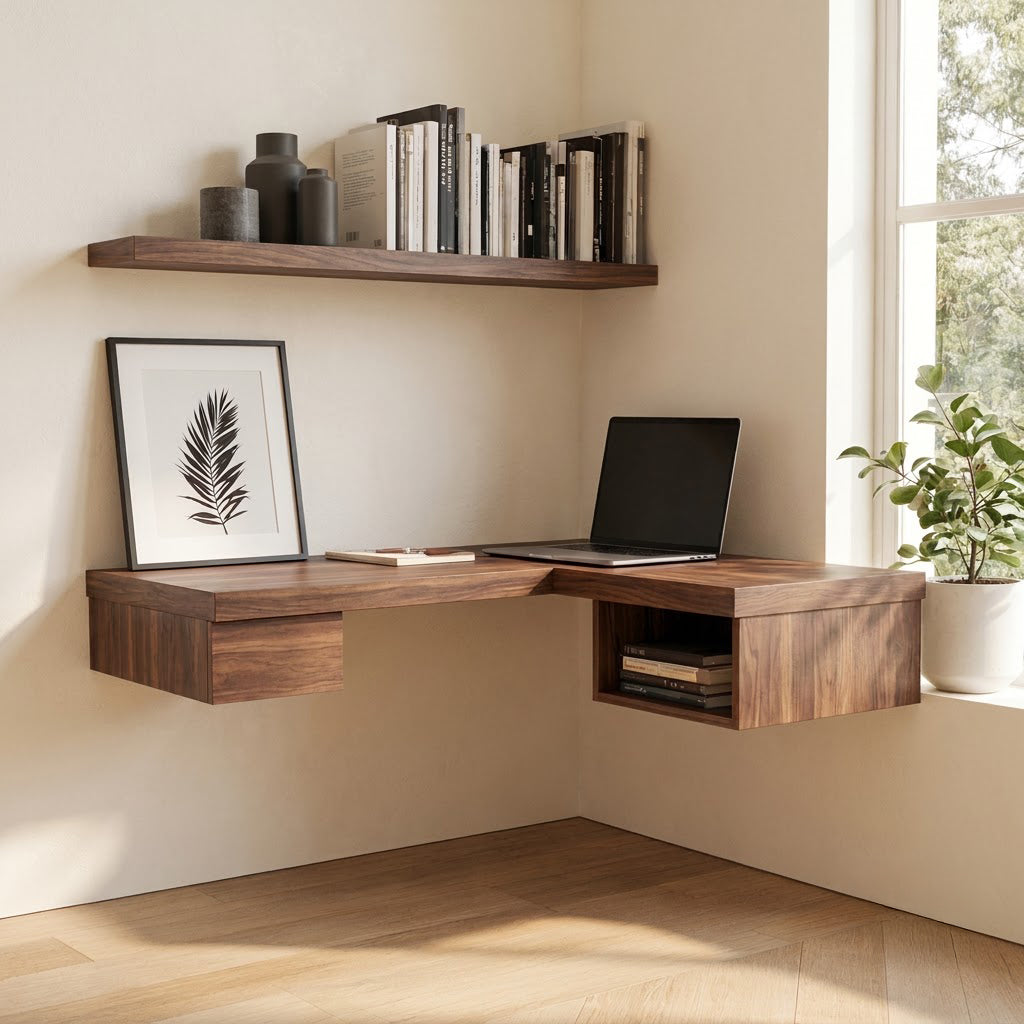
A corner desk is designed specifically to fit into a corner, but its desktop can take different forms, including curved, angled, or L-shaped configurations. The defining feature is how the desk is designed to use the corner of the room.

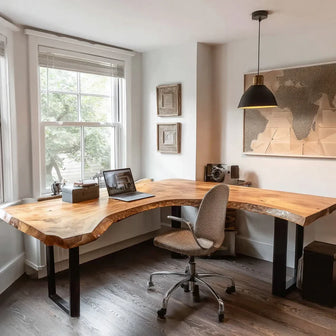
An L-shaped desk has two connected work surfaces that meet at roughly a 90-degree angle. The two sides create separate but connected work zones, making this configuration useful when you need more workspace than a single straight desk can provide.

| Feature | Corner Desk | L-Shaped Desk |
|---|---|---|
| Basic layout | Designed to fit into a corner; shape can vary | Two connected surfaces meeting at an angle |
| Work zones | Usually centered around one primary workstation | Can create two distinct working areas |
| Best for | Corner nooks, compact workspaces, single workstations | Multi-monitor setups, creative work, larger home offices |
| Surface area | Depends heavily on the shape and dimensions | Generally provides more continuous workspace across two sides |
| Room footprint | Can be compact, depending on configuration | Usually extends farther along both walls |
Corner Desk vs L-Shaped Desk for Different Workspaces
The biggest practical difference is not simply the name of the desk. It is how the available surface is divided and how you intend to use it.
A compact corner desk can work well when you have one primary workstation and want to make use of a difficult corner without filling two walls with furniture.
An L-shaped desk creates a more substantial wraparound workspace. One side can hold monitors and a computer while the other provides room for writing, paperwork, creative work, books, or additional equipment.
That makes the L-shaped configuration particularly useful when your desk needs to perform more than one function during the day.



When to Choose a Corner Desk
A corner desk can make sense when your priority is fitting a dedicated workstation into a specific corner rather than creating two separate work zones.
- You have a compact corner or defined nook. A smaller corner configuration can make use of space that might otherwise remain empty.
- You mainly use one workstation. If your daily setup is a laptop or single-monitor computer, you may not need the additional surface of a large L-shaped desk.
- You want a visually compact workspace. A smaller corner desk can keep the surrounding room more open, particularly in a bedroom or multipurpose room.
- You do not need two separate work surfaces. If everything you use regularly fits within one primary working area, the second wing of an L-shaped desk may not add much practical value.
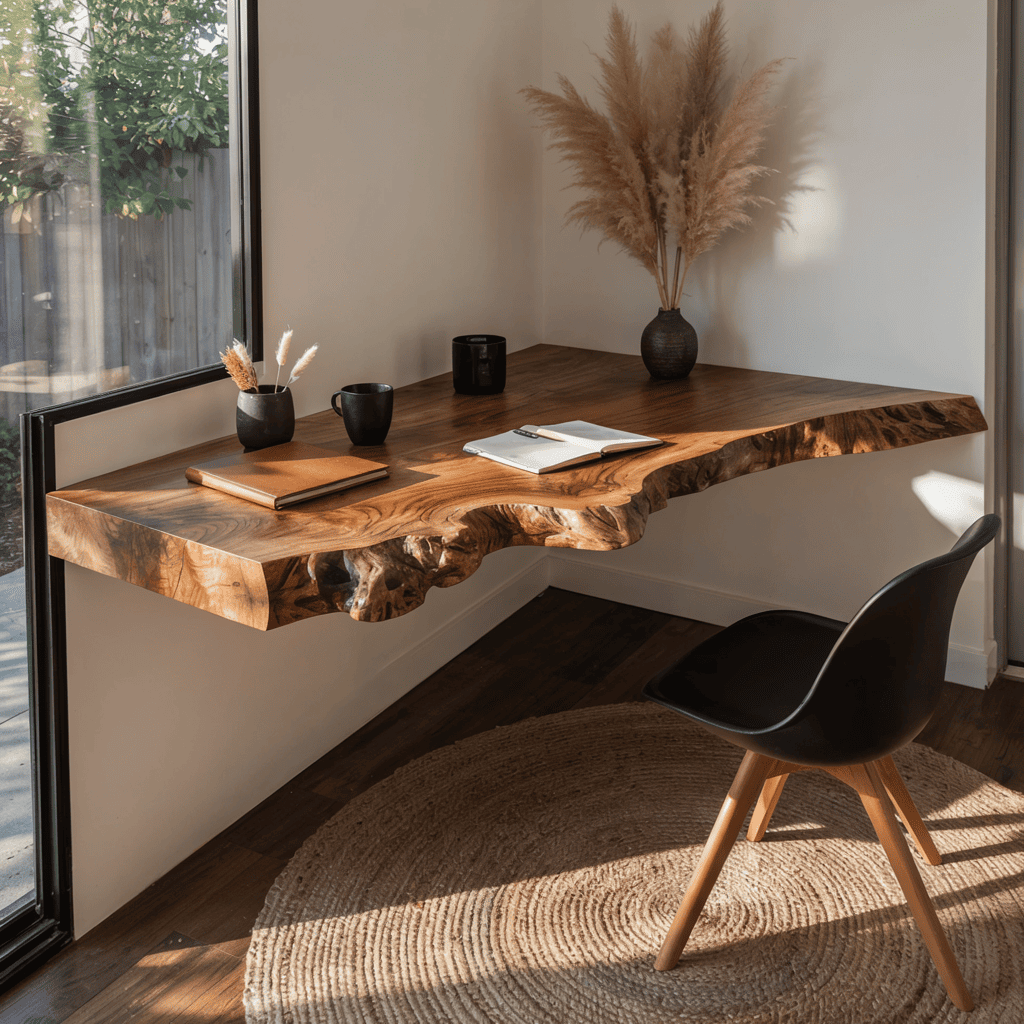
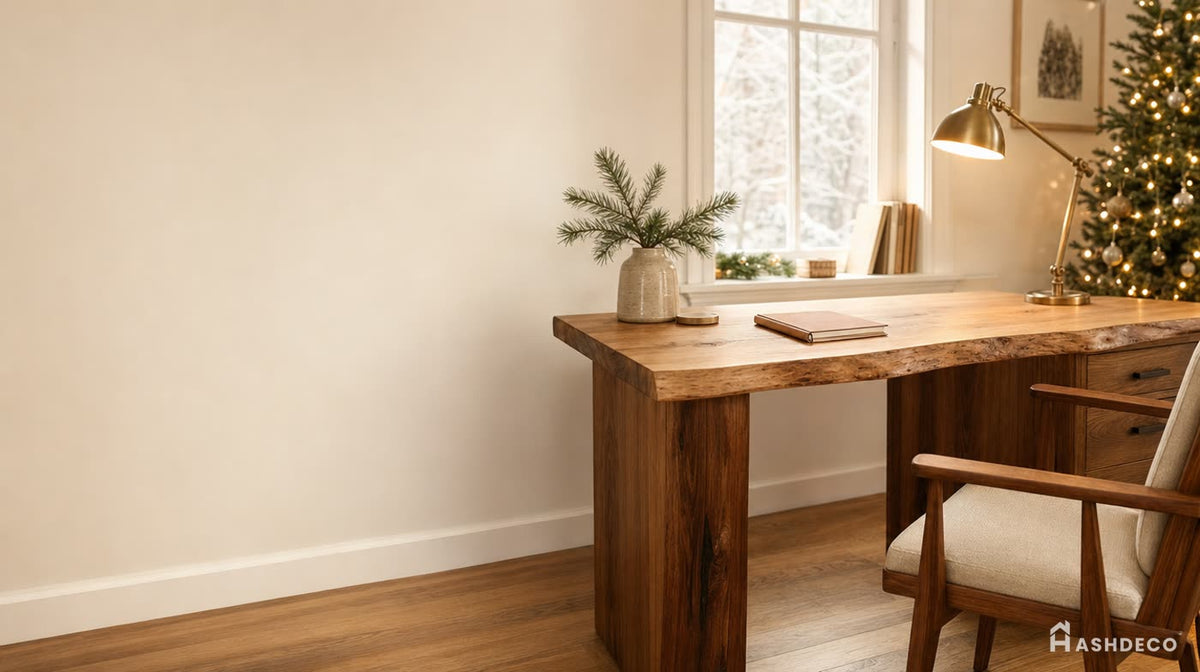
Ashdeco's Sculptural Floating Live Edge Solid Wood Corner Desk is designed around a compact floating corner configuration, while the Corner Live Edge Solid Wood Desk combines a corner-oriented layout with a spacious L-shaped top.
When to Choose an L-Shaped Desk
An L-shaped desk is worth considering when you need more than one usable working zone or want your desk to support several activities at once.
- You use multiple monitors. The two connected surfaces can provide more room to position screens, peripherals, and other equipment.
- You work with physical materials. One side can hold a computer while the other provides dedicated space for sketching, paperwork, studying, or creative projects.
- You need more workspace without adding a second desk. An L-shaped configuration combines two work areas into one piece of furniture.
- You have enough wall and floor space. Check the dimensions of both sides before ordering, because a large L-shaped desk can extend significantly along each wall.
Ashdeco offers several L-shaped configurations, including the Live Edge L-Shaped Desk with Metal Legs, the Organic Live Edge Solid Wood L-Shaped Corner Desk, and floating L-shaped desks with integrated storage.

Don't miss
These pieces qualify for 10% off orders over $2,000. Applied automatically at checkout.
10% off
Live Edge L-Shaped Desk – Handmade Solid Wood Corner Desk for Home Office
From $2,340.00
10% off at checkout
10% off
Handmade Live Edge Desk – Rustic Solid Wood Office Workstation for Home or Studio
From $2,860.00
10% off at checkout
10% off
Modern Live Edge L Shaped Desk For Study Room
From $2,340.00
10% off at checkout
 10% off
Pill Contoured A Line Base Dressing Table in Handcrafted Solid Wood
From $2,265.00
10% off at checkout
Corner Desk vs L-Shaped Desk: Size and Space Requirements
Before choosing between the two, measure the actual corner rather than relying on the visual impression of a product photo.
Measure Both Walls Before Choosing a Corner Desk
For a corner configuration, measure the available wall length on both sides of the corner. Check for windows, doors, baseboards, outlets, and other furniture that could interfere with the desktop.
Check Both Wings of an L-Shaped Desk
With an L-shaped desk, measure each side independently. A desk listed as 59" x 59", for example, needs usable space along both walls rather than only a 59-inch section on one side.
Ashdeco's L-shaped models are available in different configurations and dimensions. One current solid wood L-shaped model offers sizes from 47" x 47" up to 79" x 79", while another floating L-shaped model offers widths from 50" to 72". Always check the specific product dimensions before ordering.
Leave Room for Your Chair and Movement
The desktop is only part of the footprint. Leave enough open space behind and beside your chair to sit comfortably, move away from the desk, and access drawers or storage.

Corner Desk vs L-Shaped Desk: Storage and Workspace
Storage is another important difference when comparing the two configurations.
Storage on a Corner Desk
Compact corner desks often prioritize the desktop itself, particularly floating designs. This can create a clean workspace with open floor space underneath, but built-in storage varies by model.
Storage on an L-Shaped Desk
The additional wing of an L-shaped desk can create more room for integrated drawers, shelves, or separate equipment zones. For example, Ashdeco's floating L-shaped corner desk combines two work surfaces with integrated storage cubbies and a drawer.
Think About What You Actually Need Within Reach
More desktop does not automatically mean a better workspace. Consider what needs to remain within arm's reach every day: monitors, keyboard, notebook, drawing materials, paperwork, or storage. Choose the configuration that puts those items where you will actually use them.

A Simple L-Shaped Desk vs Corner Desk Decision Framework
Use these questions to narrow down the right configuration:
1. Do you need one primary workstation or two connected work zones?
- One primary workstation → consider a corner desk.
- Two connected work zones → consider an L-shaped desk.
2. How much space is available along both walls?
- Limited space → look for a compact corner configuration.
- More room along both walls → an L-shaped desk may make better use of the available area.
3. What equipment and materials need to stay on the desk?
- Laptop or single monitor → a smaller configuration may be enough.
- Multiple monitors, paperwork, drawing materials, or separate equipment → an L-shaped surface may be more practical.
4. Do you need integrated storage?
- Minimal storage needs → a simple corner desk may be sufficient.
- Drawers, shelves, or separate storage zones → look for an L-shaped model designed with built-in storage.
Corner Desk vs L-Shaped Desk: Other Factors to Consider
Visual Weight in the Room
A compact corner desk can leave more of the surrounding room visually open. A large L-shaped desk occupies more wall length and naturally becomes a stronger part of the room's layout.
Workspace Organization
An L-shaped desk can naturally separate activities. You might keep monitors and computer equipment on one side while using the other for writing, reading, crafting, or paperwork.
Construction and Joinery
With an L-shaped solid wood desk, pay attention to how the two sections are connected and supported. A well-designed joint and support structure matter because the corner connection carries the load of both surfaces.
Cost
Price depends on material, size, construction, finish, storage, and whether the desk is floating or freestanding. A larger L-shaped desk may cost more simply because it uses more material and requires a more complex construction than a smaller corner configuration.
Ashdeco Corner and L-Shaped Desk Options
Ashdeco's current desk collection includes both corner-oriented and L-shaped designs, including floating and freestanding configurations.
Corner Desk Options
- Floating corner desk: Sculptural Floating Live Edge Solid Wood Corner Desk
- Live edge corner desk: Corner Live Edge Solid Wood Desk - Organic Modern Writing Table
L-Shaped Desk Options
- Live edge L-shaped desk: Live Edge L-Shaped Desk with Metal Legs
- Floating L-shaped desk with storage: Modern Handcrafted Solid Wood Floating L-Shaped Corner Desk with Storage
- Organic live edge L-shaped desk: Organic Live Edge Solid Wood L-Shaped Corner Desk
Several of these designs use solid wood construction, while the live edge models preserve the natural contour of the timber. The exact dimensions, support system, storage, and available customization vary by product, so review the individual product page before ordering.
Browse the full range in our solid wood desk collection.
L-Shaped Desk vs Corner Desk FAQs
Is an L-shaped desk the same as a corner desk?
Not necessarily. A corner desk is designed to fit into a corner, while an L-shaped desk uses two connected work surfaces that meet at an angle. The terms can overlap because an L-shaped desk is often designed specifically for corner placement.
What is the difference between an L-shaped desk and a corner desk?
The main difference is the layout of the work surface. A corner desk can have different shapes depending on the design, while an L-shaped desk specifically creates two connected surfaces that form an L. Always check the actual dimensions and desktop shape rather than relying only on the product name.
Is an L-shaped desk good for two monitors?
Yes. An L-shaped desk can provide more continuous surface for multiple monitors, peripherals, and other equipment. The two sides can also help separate screens and other work materials into different zones.
Does an L-shaped desk take up more space than a corner desk?
Often, but it depends on the dimensions. An L-shaped desk can extend along both walls and therefore require more usable wall and floor space. A compact corner desk may have a smaller footprint, but the actual dimensions should always be checked before choosing.
What size corner desk should I get?
Choose a size based on the available wall space, your chair clearance, and the equipment you need on the desktop. Measure the corner first, then compare the desk's width, depth, and height with the available space.
Is an L-shaped desk good for a small home office?
It can be, provided the dimensions fit the room. A smaller L-shaped desk can create two connected work zones without requiring two separate desks, but you should measure both walls and the chair clearance before ordering.
Can a corner desk have an L-shaped top?
Yes. A desk can be designed specifically for corner placement while using an L-shaped desktop. Ashdeco's Corner Live Edge Solid Wood Desk, for example, is described as a corner desk with a spacious L-shaped top.
Choose the Desk Shape Around How You Work
Neither an L-shaped desk nor a corner desk is automatically right for every room. The better choice depends on the available space, the amount of surface you actually need, and whether your work benefits from one primary workstation or two connected zones.
If you need a compact setup for one main workstation, start by comparing corner desk dimensions and available configurations. If you regularly use multiple monitors, separate work materials, or need distinct areas for computer and creative work, an L-shaped desk may better match your workflow.
The key is to measure the room first, then choose the desk shape that uses that space intentionally.