






















Quick view
- Quick Comparison Table
- 1. Natural Driftwood Standing Coat Rack - Best Overall
- 2. Vintage 10-Hook Stand - Best Budget
- 3. Artisan Sculptural Hall Tree - Best for Small Spaces
- 4. Sculptural Tree Hall Tree - Best Statement Piece
- 5. Tree Coat Stand Bench - Best with Seating
- 6. Sculptural Branch Coat Rack - Best Luxury Pick
- Six racks, zero MDF, zero wobble
- Why Handcrafted Solid Wood Beats Mass-Produced Coat Stands
- How to Pick the Right Standing Coat Rack
- FAQs
Shop this guide
Handcrafted Cat Tree Tower, made to order in solid wood.
 Sculptural Spiral Solid Wood Cat Tree Tiered Modern Feline Lounger
From $2,217.0010% off at checkout
Sculptural Spiral Solid Wood Cat Tree Tiered Modern Feline Lounger
From $2,217.0010% off at checkout
 Nature Inspired Branch Solid Wood Corner Cat Tree Tower Condo
From $1,854.00
Nature Inspired Branch Solid Wood Corner Cat Tree Tower Condo
From $1,854.00
 Live Edge Slice Tiered Solid Wood Cat Tree Freestanding Multi Level Perch
From $1,732.00
Live Edge Slice Tiered Solid Wood Cat Tree Freestanding Multi Level Perch
From $1,732.00
 Artisanal Solid Wood Sculptural Tree Cat Tower & Multi-Tier Botanical Display Perch Stand
From $2,076.0010% off at checkout
Artisanal Solid Wood Sculptural Tree Cat Tower & Multi-Tier Botanical Display Perch Stand
From $2,076.0010% off at checkout
 Sculptural Hand-Carved Tree Solid Wood Wall-Mounted Cat Climbing Tower with Dual House Condos & Display Shelves
$3,012.0010% off at checkout
Sculptural Hand-Carved Tree Solid Wood Wall-Mounted Cat Climbing Tower with Dual House Condos & Display Shelves
$3,012.0010% off at checkout
 Sculptural Hand-Carved Tree Solid Wood Cat Tower & Multi-Tier Luxury Feline Climbing Tree with Tunnel Condo Base
From $2,654.0010% off at checkout
Sculptural Hand-Carved Tree Solid Wood Cat Tower & Multi-Tier Luxury Feline Climbing Tree with Tunnel Condo Base
From $2,654.0010% off at checkout
Best Standing Coat Racks 2026: 6 Handcrafted Picks, Tested and Ranked
We tested and ranked 6 handcrafted solid wood standing coat racks for 2026 by stability, hook count, style, and value. Here's the verdict:
- Best overall: Natural Driftwood Coat Rack ($1,056) - organic branch design, kiln-dried solid wood, fits most entryways
- Best budget: Vintage 10-Hook Stand ($520) - classic post style, highest hook-to-price ratio
- Best luxury: Sculptural Branch Coat Rack ($4,833) - 80-inch statement piece for grand entryways
Most "best coat rack stand" articles you find on Google are buying guides in disguise. They spend 3,000 words telling you how to pick a standing coat rack without naming a single product you can actually buy. That's about as useful as a recipe that tells you how to cook without listing ingredients. (If you do want the fundamentals first - types, materials, sizing, weight capacity - our Coat Rack Buying Guide 2026 covers all of that.)
We went the other way. Below are 6 real handcrafted solid wood standing coat racks - made by Ashdeco's artisans in Vietnam - compared side by side. You'll see the actual price, dimensions, hook count, and an honest breakdown of what each one does well and where it falls short.
Every rack on this list is built from solid hardwood. No veneer. No MDF. No hollow metal tubes pretending to be wood. The hooks are carved from the same piece of wood as the post, not screwed on afterward. That matters because screw-attached hooks loosen over time - integral hooks don't. If you want the full breakdown on why solid wood beats mass-produced alternatives, we cover that below the reviews. For now, let's get to the racks.
Quick Comparison Table
| Standing Coat Rack | Price | Height | Hooks | Base | Best For |
|---|---|---|---|---|---|
| Natural Driftwood Coat Rack | $1,056 | 60" | 8-10 branches | Cross base | Everyday entryway, organic look |
| Vintage 10-Hook Stand | $520 | 60" | 10 pegs | Round disc | Budget-friendly classic post style |
| Artisan Sculptural Hall Tree | $1,123 | ~65" | 6-8 branches | Wide base | Apartments, compact entryways |
| Sculptural Tree Hall Tree | $1,876 | 70" × 40"W | 8-12 branches | Sculptural base | Dramatic foyer, high ceilings |
| Tree Coat Stand Bench | $2,234 | ~72" | 8-10 branches | Bench base | Entryway with seating, families |
| Sculptural Branch Coat Rack | $4,833 | 80" × 80"W | 12+ branches | Root base | Grand entryways, luxury interiors |
1. Natural Driftwood Standing Coat Rack - Best Overall
Price: $1,056 | Height: 60" | Material: Solid driftwood, kiln-dried

See the Natural Driftwood Coat Rack →
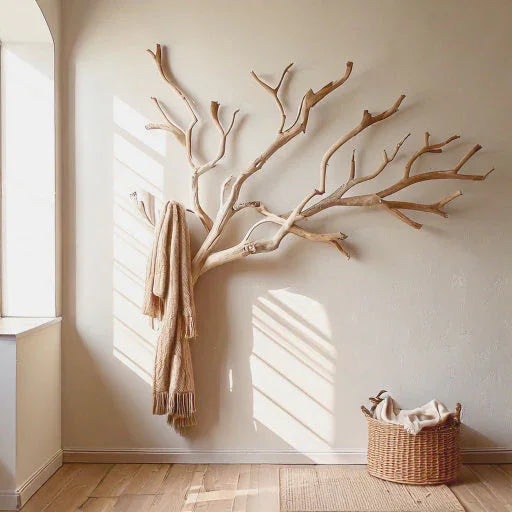
If you want that organic tree-branch silhouette without spending north of two grand, this is the one. At 60 inches, it tucks neatly under a standard 8-foot ceiling but still gives you enough hooks for three or four people's daily rotation of coats, bags, and scarves.
The base is the same solid driftwood as the rest of the rack - no hollow metal disc dressed up to look like wood. After sitting outside for 18 months then going through a kiln, this wood isn't going anywhere. No warping, no cracking, no drama. And because the branch hooks are carved directly into the piece instead of screwed on as an afterthought, you'll never deal with that infuriating loose-hook-wobble that cheap racks develop within a year. If driftwood's organic look isn't quite your style, our wood coat rack styles guide breaks down tree, driftwood, and modern options side by side, and our eco-friendly coat racks guide covers sustainable wood picks like this one in more depth.
What we like: Natural driftwood means every piece is one of a kind. Branch hooks actually grip fabric, unlike smooth metal pegs where your scarf slides off if you breathe near it. At roughly $53 a year across its lifespan, you're paying less annually than a Netflix subscription for furniture that outlasts your mortgage.
What to know: At 60 inches, it can look a bit squat in rooms with 10-foot ceilings. Also, those branches need about 22 to 24 inches of floor diameter for coats to hang without brushing against the wall - not huge, but worth measuring before you buy.
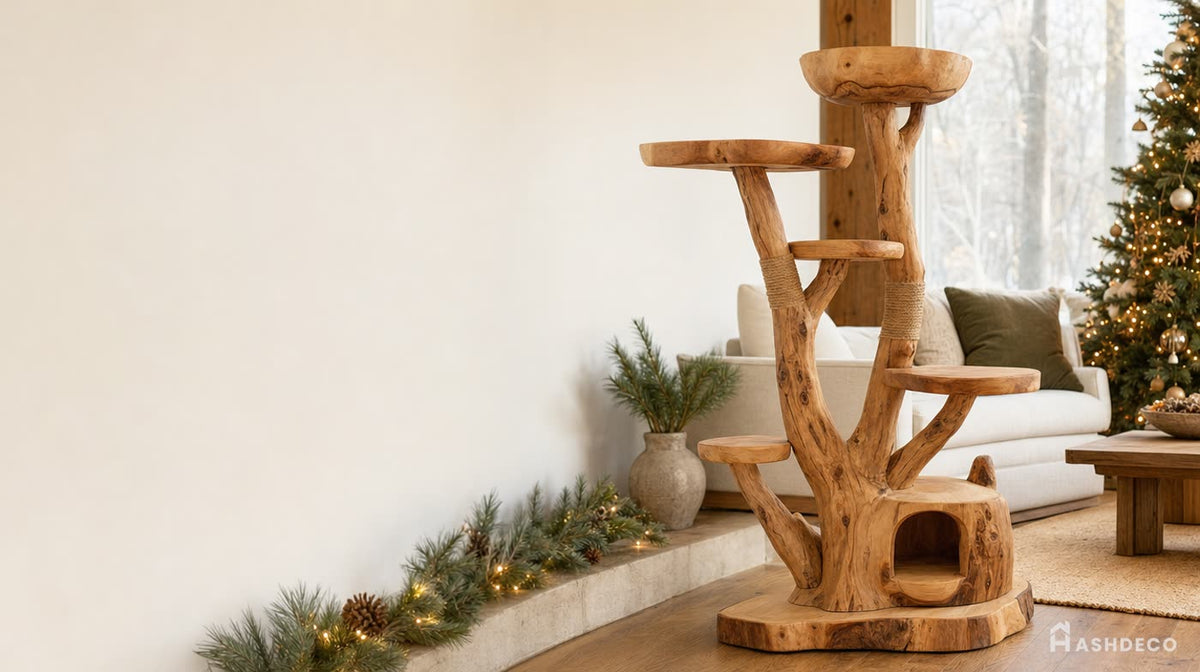


2. Vintage 10-Hook Stand - Best Budget
Price: $520 | Height: 60" | Hooks: 10 rounded pegs | Base: Solid wood disc

See the Vintage 10-Hook Stand →
If your budget says "IKEA" but your standards say "I want something that doesn't wobble when I hang a winter coat on it" - here's your answer. At $520, it's the most affordable solid wood standing coat rack in Ashdeco's lineup, but nobody cut corners to get there. For more picks at this price point, see our Best Wooden Coat Racks 2026 roundup, which compares standing, wall, and tree options across every budget tier.
The central post is a single thick piece of hardwood, not two skinny poles joined in the middle (that seam is where budget racks fail - if you've owned one, you know exactly the spot I'm talking about). The round disc base distributes weight evenly. Ten hooks spaced around the post means you can load coats on all sides without the rack starting to lean.
Styling-wise, this is the most understated rack on the list. Clean lines, warm wood finish, rounded pegs. It blends into whatever decor you already have instead of screaming for attention. Whether that's a pro or a con depends entirely on whether you want your coat rack to be a conversation piece or just a really good coat rack. If you're renting and want something that requires zero drilling, our coat rack for renters guide covers exactly this kind of no-commitment, freestanding pick.
What we like: Ten hooks for $520 - best hook-to-dollar ratio in the entire collection. The classic design works in literally any room style. At $26 a year across its lifespan, it's cheaper than your annual coffee budget.
What to know: It won't win any sculpture awards - the tree-branch designs are more visually striking. Smooth peg hooks can let silky scarves and thin bag straps slip off easier than textured branch hooks. And being single-height, kids will need a step stool or a separate lower hook elsewhere - see our coat hook height guide for the right mounting height by age.
3. Artisan Sculptural Hall Tree - Best for Small Spaces
Price: $1,123 | Height: ~65" | Base: Wide, stable footprint

See the Artisan Sculptural Hall Tree →
Not everyone has a grand foyer. If your entryway is more "narrow apartment hallway" than "covered front porch," this standing coat rack gives you the handcrafted look without dominating the room. The branches angle upward rather than outward, so coats drape closer to the central post and don't need as much wall clearance. For more layout-specific picks, our wall-mounted coat rack ideas for small spaces and small entryway ideas guides cover the full range of compact-footprint options, standing and wall-mounted alike.
The base spreads wide enough to prevent tipping even when every coat is on one side (which, let's be honest, is exactly how people actually use a coat rack). But the overall silhouette stays compact - it's there when you need it, invisible when you don't.
This piece comes out of Ngoc Vo's workshop, and you can tell. The wood grain is visible and tactile. Nobody painted over it to hide cheap material underneath. At about $56 a year across its lifespan, it costs less annually than a decent dinner out.
What we like: Compact footprint that actually fits in apartments. Upward-angled branches = less wall clearance needed. Genuinely sculptural without overwhelming a small room. Zero installation - no wall drilling, no lease violations.
What to know: Six to eight branches means fewer hooks than the full-size tree models. If your household has four people plus frequent guests, you might max out the hanging capacity on busy days. Not the rack to buy if you live in Alaska and everyone owns three parkas.
Don't miss
These pieces qualify for 10% off orders over $2,000. Applied automatically at checkout.
10% off
Sculptural Spiral Solid Wood Cat Tree Tiered Modern Feline Lounger
From $2,217.00
10% off at checkout
10% off
Artisanal Solid Wood Sculptural Tree Cat Tower & Multi-Tier Botanical Display Perch Stand
From $2,076.00
10% off at checkout
10% off
Sculptural Hand-Carved Tree Solid Wood Wall-Mounted Cat Climbing Tower with Dual House Condos & Display Shelves
$3,012.00
10% off at checkout
10% off
Sculptural Hand-Carved Tree Solid Wood Cat Tower & Multi-Tier Luxury Feline Climbing Tree with Tunnel Condo Base
From $2,654.00
10% off at checkout
4. Sculptural Tree Hall Tree - Best Statement Piece
Price: $1,876 | Dimensions: 70"H × 40"W | Crafted by: Ngoc Vo

See the Sculptural Tree Hall Tree →
This standing coat rack is the one your guests walk in and immediately ask "where did you get that?" At 70 inches tall with branches spreading 40 inches wide, it fills a proper entryway the way a chandelier fills a dining room - it's furniture that doubles as art.
The base isn't just a flat wooden pancake. It's sculptural - designed as part of the overall silhouette - but it does the real work of keeping the center of gravity low even when heavy winter coats hang on the outer branches. Each branch-to-trunk connection uses mortise-and-tenon joinery. That's the same technique used in high-end chair making. It gets tighter over time as the wood settles, not looser.
With 8 to 12 branches at different heights, adults grab the upper hooks, kids reach the lower ones, and bags and scarves find their own spots in between. Nobody fights for the same hook space.
What we like: Museum-quality design that actually holds coats. Multiple hook heights work for the whole family - no need for a separate kids' rack. Solid joinery throughout, nothing glued on as a shortcut. Runs about $94 a year across its lifetime.
What to know: You need a real entryway - this isn't for narrow hallways or tight apartment corners. With 40-inch width plus coat clearance, budget about five to six feet of wall space. The price is premium, but so is the craftsmanship.
5. Tree Coat Stand Bench - Best with Seating
Price: $2,234 | Height: ~72" | Design: Tree coat rack with integrated wooden bench

See the Tree Coat Stand Bench →
A standard coat rack stand holds coats. This one holds coats and you - while you're putting on your shoes. That built-in solid wood bench turns what would normally be two separate pieces of furniture (coat rack + entryway bench) into one. If you've ever tried to balance on one foot in a narrow hallway while lacing up boots, you already know why this matters.
Stability-wise, a bench base is basically cheating - in the best way. No round disc or cross-base design can compete with the sheer planted weight of a solid wood bench anchoring the entire structure. Even if every coat in your household hangs on the same side (teenagers, I'm looking at you), the bench counterweight keeps the rack exactly where it belongs. This is also why bench-base hall trees rank among the most tip-resistant designs in our family coat rack stability guide - low center of gravity beats a wide footprint alone.
The bench seats a full adult comfortably - it's not one of those decorative half-benches that exist only in product photos. For families with young kids who need to sit down for the shoe-putting-on ritual, or for anyone who wants to stop buying entryway furniture one piece at a time, this is the most practical standing coat rack on the list.
What we like: Two furniture pieces merged into one - less spending, less floor space, less clutter. The bench base makes tipping physically impossible. Solid wood bench rated for an adult, not just decorative. Functions as both art and a legitimate entryway workstation.
What to know: The biggest footprint of all six - you need at least four feet of depth. At $2,234, it's a considered purchase, not an impulse buy. It's heavy enough that you'll pick its spot once and leave it there, so plan accordingly.
6. Sculptural Branch Coat Rack - Best Luxury Pick
Price: $4,833 | Dimensions: 80"H × 80"W | Crafted by: Ngoc Vo

See the Sculptural Branch Coat Rack →
This is the flagship. At 80 inches tall with an 80-inch branch spread, it's less furniture and more installation art that happens to hold your coats. If your entryway has 10-foot ceilings and enough square footage that "spacious" doesn't feel like an exaggeration, this piece fills it properly. For our full walkthrough of why tree-style racks work as centerpiece furniture, see the Tree Coat Rack Guide.
Stability isn't even a conversation with this one - the thing weighs enough that you'd need actual effort to tip it over. Solid hardwood throughout, 12+ thick branches, a massive root-style base. You could hang a wet winter parka from the furthest branch and the rack wouldn't flinch.
Every branch is carved individually and joined using traditional Vietnamese woodworking techniques. The finish is applied by hand, pulling out the grain patterns that make each piece unmistakably one of a kind. At $4,833, it's priced like furniture that'll outlive you - because it will. That works out to about $242 a year over two decades, which is roughly what you'd spend on a mid-tier dresser from a chain store that disintegrates in year six.
What we like: This is the only coat rack a guest will ever photograph. Twelve-plus heavy-duty branches at different heights. Solid wood at a scale that's genuinely rare in furniture today. Truly one of a kind - no two pieces share the same branch arrangement or grain pattern.
What to know: Nearly five thousand dollars - not a "maybe I'll grab one" purchase. You need a genuinely large entryway with high ceilings. Shipping coordination is involved (Ashdeco handles this, but it's not an Amazon Prime box on your doorstep situation).

Handcrafted in Vietnam
Six racks, zero MDF, zero wobble
Every standing coat rack above is carved from solid hardwood by Vietnamese artisans - hooks included, not screwed on as an afterthought.
Browse all standing coat racks →Why Handcrafted Solid Wood Beats Mass-Produced Coat Stands
We've all owned that $60 metal tube coat rack from Target. Day one: already wobbling. Month six: hooks starting to bend. Year two: in the garage, leaning against a wall, holding nothing but resentment. Here's why handcrafted solid wood is a different universe:
Weight equals stability. A solid wood standing coat rack tips the scale at 8 to 15 pounds empty. A budget metal rack? Three to five pounds. When you grab a heavy coat off a hook, that extra mass keeps the rack planted where it belongs. Physics is on your side.
Hooks that don't quit. Factory racks attach hooks with screws. The screw threads slowly chew up the wood around them, and one day the hook wiggles loose or snaps clean off. Ashdeco's branch hooks are carved from the same piece of wood as the body - there's nothing to loosen, nothing to fail, nothing to replace.
It gets better with age. Solid wood develops a patina over the years. Surface scratches blend into the grain. The color deepens. Metal racks do the opposite - they chip paint, rust at the joints, and look progressively sadder with each passing season.
Real joinery, not glue and hope. Mortise-and-tenon connections, dowel joints, and threaded inserts - these techniques get tighter as the wood moves with seasonal humidity. Glue-only joints (standard on "wood" racks that are actually MDF with a wood-print sticker) fail on a predictable timeline. Usually right around month eight.
Hands, not machines. Every piece is unique because an actual human looked at the wood, felt the grain, and made decisions no factory robot can. You're not buying a SKU off a warehouse shelf. You're buying something someone made.
How to Pick the Right Standing Coat Rack
Now that you've seen the lineup, here's the cheat sheet:
Ceiling height first. 8-foot ceilings → 60-66" racks (#1, #2, #3). 9-foot ceilings → 70" models (#4, #5). 10+ foot ceilings → go big with #6. Short racks in tall rooms look lost. Tall racks in short rooms feel like they're about to punch through the ceiling.
Measure your actual floor space. Take the rack's listed width and add 12-18 inches on each side for coats to hang naturally. A 40-inch rack like #4 needs roughly five to six feet of total clear space. If your hallway is 36 inches wide, you're looking at a wall-mounted coat rack instead of a standing one.
Count your people, add spares. One hook per person, plus extras for guests, bags, scarves, and that one jacket you never actually wear but won't get rid of. A couple needs six-plus hooks. A family of four should aim for ten or more. Picks #1, #2, #4, and #6 all clear that threshold comfortably.
Standing vs. wall-mounted. If you rent and can't drill holes, standing is your only sensible option. If you have zero floor space but plenty of wall, our wall-mounted coat racks and hangers might serve you better. If you have the floor space, standing racks give you 360-degree access, zero wall damage, and the flexibility to move them whenever you rearrange.
Need more specifics on choosing between the two? We broke down every detail in our wall-mounted vs standing coat rack comparison.
FAQs
What is the best standing coat rack for 2026?
Based on stability, hook count, and value, the Natural Driftwood Coat Rack ($1,056) is the best overall pick for most entryways. For tighter budgets, the Vintage 10-Hook Stand ($520) delivers the best hook-to-price ratio. For grand entryways, the Sculptural Branch Coat Rack ($4,833) is the top luxury choice. If none of these quite fit your space, our full coat rack buying guide covers wall-mounted and hook-rail alternatives too.
How do I stop a standing coat rack from tipping over?
Buy one made of solid wood with a wide base. Every rack on this list has a base spanning 16+ inches and weighs at least 8 pounds empty. Place it against a wall or in a corner for extra insurance. But honestly? The base weight alone does the heavy lifting - a quality solid wood rack doesn't tip even freestanding in the middle of a room. Lightweight metal or bamboo racks tip no matter where you put them. For the exact base-to-height ratio we use to judge stability, see our 40% rule guide.
How many coats can one standing coat rack actually hold?
Each solid wood branch hook holds 10 to 15 pounds without complaint. A heavy winter coat weighs about 3 to 5 pounds, so each hook easily handles one coat plus a scarf or bag. A 10-hook rack handles 8 to 10 coats comfortably. If you cram 15 coats onto 10 hooks, you're the problem, not the rack. See our Coat Rack Weight Test for the full load-testing data behind these numbers.
What's the difference between a coat rack stand and a hall tree?
A coat rack stand is a freestanding pole or tree with hooks - it holds coats, hats, and bags. That's it. A hall tree adds storage: usually a bench, shelf, shoe rack, or mirror built into the base. On this list, picks #4, #5, and #6 blur the line - they're sculptural hall trees that function as both art and entryway workhorses. If you want the full breakdown, read our hall tree vs coat rack comparison.
What wood should I look for in a standing coat rack?
Hardwoods, every time: oak, walnut, acacia, beech. They're dense enough to shrug off daily dings from zippers and keys, and heavy enough to anchor the rack. Avoid pine - it dents if you look at it wrong. And anything described as "engineered wood," "wood composite," or "MDF with wood veneer" is particle board wearing a costume. It'll fail. It's just a question of when. For a wood-by-wood breakdown, see Best Wooden Coat Racks 2026, and for sustainably sourced options specifically, our eco-friendly coat racks guide.
Can I use a standing coat rack as a renter?
Not just "can" - standing coat racks are the renter's best friend. No drilling. No wall anchors. Nothing that'll cost you your security deposit. When you move, you take it with you. Compare that to a wall-mounted coat rack that leaves screw holes you'll be patching and painting over at 11 PM the night before your lease inspection. More on that in our standing vs wall-mounted guide.
How long does a handcrafted solid wood coat rack stand actually last?
Twenty-plus years with basic care - dust it occasionally, wipe it with a damp cloth, apply wood oil once or twice a year. Solid wood doesn't have the failure points that doom mass-produced racks: no glued joints to separate, no screw holes to enlarge, no veneer to peel, no particle board to swell up in humidity. It's the kind of furniture your kids argue over who gets to inherit. See how a tree coat rack is made for what actually goes into that longevity.
Are these coat rack stands hard to assemble?
They arrive mostly assembled. The heavy lifting - joinery, finishing, branch attachment - is all done in the workshop. You might need to attach the base to the post (usually a simple threaded connection) and that's about it. No Allen wrench marathons. No instruction manuals written in six languages where none of the diagrams make sense.
Free US shipping · Made to order · 30-day returns · 1-year warranty
Browse all handcrafted standing coat racks →