
Traditional Bathroom Vanities Design
1. Why Choose a Traditional Bathroom Vanity
A traditional bathroom vanity stands on the floor - legs, a cabinet base, or both - with a countertop, sink, and built-in storage. It's the classic bathroom vanity format that has worked for decades because it does everything well: stores towels and toiletries behind cabinet doors, supports heavy countertops and sinks without wall anchoring, and anchors the bathroom with a grounded, substantial presence that wall-mounted designs simply can't replicate.
a. Solid Wood, Not Particle Board
Most traditional vanities sold online are made from MDF or particle board with a veneer finish that swells, peels, and deteriorates in bathroom humidity within a few years. Ashdeco traditional bathroom vanities are handcrafted from solid hardwood - teak, walnut, oak, acacia, and reclaimed wood - finished with moisture-resistant sealant built for daily bathroom exposure. Real wood that handles steam, splashes, and years of use without falling apart.
b. Handcrafted by Vietnamese Artisans

Every traditional vanity is built by hand - live edge countertops preserved, wood grain matched, dovetail joints and mortise-and-tenon joinery where it counts. Our artisans shape each piece to honor the natural character of the wood. Cabinet doors are fitted individually, drawers are hand-sanded for smooth action, and every surface is sealed for moisture resistance. Factory vanities are assembled; ours are crafted.
c. Maximum Storage
The biggest advantage of a traditional vanity over floating or driftwood styles: enclosed storage. Full cabinet bases with doors and drawers keep toiletries, cleaning supplies, spare towels, and bathroom essentials organized and hidden. Open shelves below the countertop offer display space for baskets and folded towels. In a master bathroom where two people share a space, that storage isn't optional-it's essential.
2. Traditional Vanity Styles We Offer
a. Farmhouse Cabinet Vanities
Reclaimed wood cabinet bodies with rustic character - visible grain, natural knots, and warm, lived-in patina. Full cabinet doors below with shelf storage inside. Live edge countertops on top. The farmhouse style that pairs with shiplap walls, apron-front sinks, and matte black fixtures. Our most popular traditional style for rustic and country-inspired bathrooms.
b. Live Edge Countertop Vanities
A solid wood slab countertop with the natural outer edge preserved - organic curves and raw character - mounted on a traditional cabinet base with storage below. The countertop is the centerpiece: natural, sculptural, one of a kind. The cabinet base keeps it practical with drawers and doors. The best of both worlds - artisan character on top, everyday function below.
c. Open Shelf Vanities
Instead of enclosed cabinet doors, these vanities feature open shelving below the countertop - perfect for woven baskets, rolled towels, and decorative storage. The open design keeps the vanity feeling lighter and less bulky than a full cabinet while still providing accessible storage. Great for guest bathrooms where you want to display fresh towels and bath essentials.
d. Double-Sink Traditional Vanities
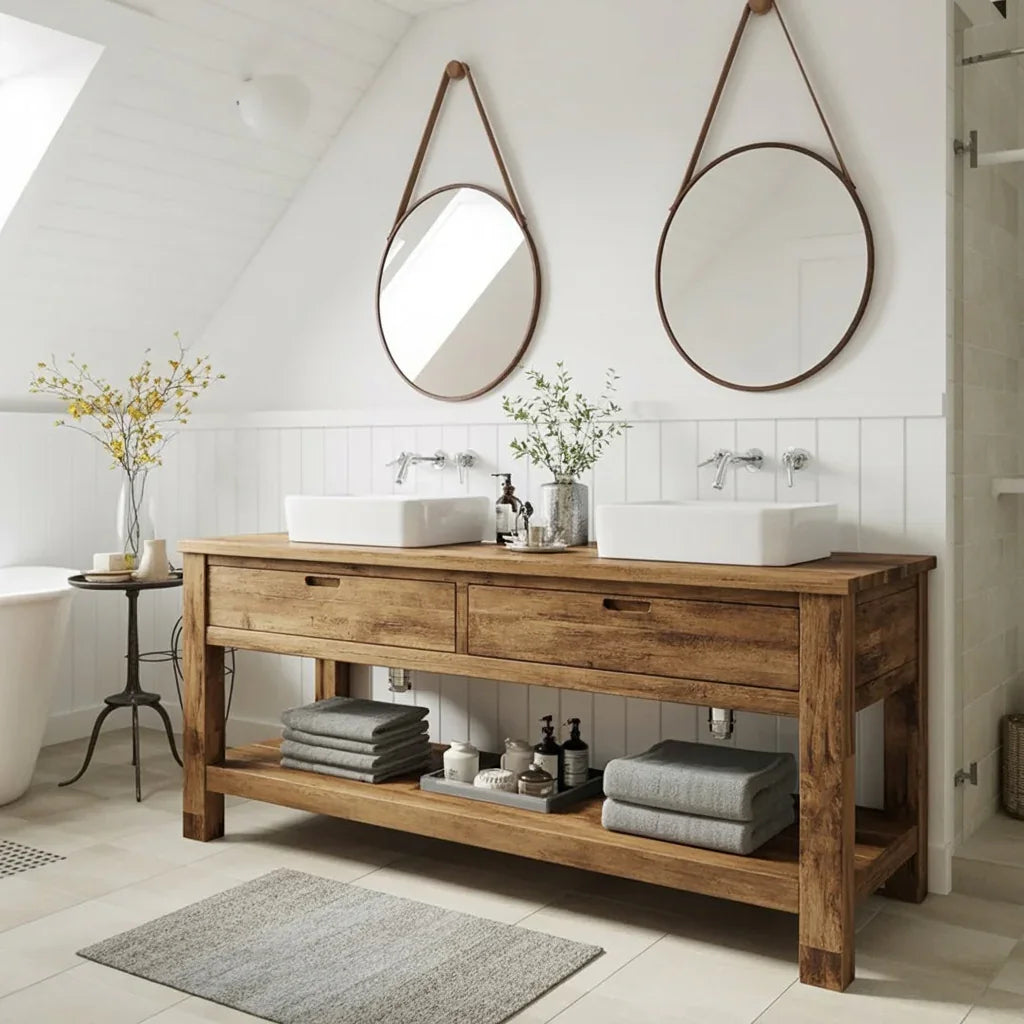
Extended-width vanities (48"-72") designed for two sinks, two mirrors, and shared or divided storage below. Essential for master bathrooms where two people get ready at the same time. Our double-sink vanities feature a continuous live edge countertop across the full width - one unbroken slab of solid wood with two vessel sinks. Storage is divided between left and right sections with drawers and cabinet space on each side.
e. Vanities with Drawers
Traditional vanities with built-in drawers - some with full drawer stacks, others combining drawers with open shelving or cabinet doors. Drawers are the most organized storage option: separate drawers for makeup, hair tools, toiletries, and cleaning supplies. Hand-sanded for smooth operation, built with solid wood fronts that match the vanity body.
3. Wood Types Used in Our Traditional Vanities
• Teak: The gold standard for bathroom wood furniture. Natural teak oils repel water and resist mold without chemical treatment. Rich golden-brown tone that deepens beautifully with age. Teak traditional vanities handle daily bathroom moisture, steam, and splashes better than any other wood species.
• Walnut: Deep, rich dark tones with dramatic, flowing grain patterns. Excellent dimensional stability - walnut resists warping and shrinking in humid environments. Our walnut vanities bring sophisticated warmth to bathrooms, especially striking against white tile, marble counters, or light-colored walls.
• Oak: Classic strength and durability with a prominent, distinctive grain pattern. Oak has been used in furniture for centuries because it's extremely hard and wear-resistant. Available in natural light tones or darker stained finishes. The most traditional choice for a traditional vanity.
• Acacia: Bold, two-tone grain with dramatic contrast between heartwood and sapwood. Hard, dense, and naturally water-resistant. Acacia traditional vanities have the most visually striking wood character of any species we offer.
• Reclaimed Wood: Salvaged timber from old structures, barns, and naturally fallen trees. Each piece carries unique history - nail holes, weathering marks, patina, and time-worn texture that can't be artificially replicated. Sustainable and full of character.
4. Traditional vs. Floating vs. Driftwood Vanities
• Traditional vanity (this collection): Floor-standing with legs or a cabinet base. Maximum enclosed storage - drawers, doors, shelves. Classic, grounded, substantial look. No wall mounting required. Best for master bathrooms, larger guest baths, and farmhouse or rustic designs where storage and presence matter most.
• Floating vanity: Wall-mounted, floor completely clear. Modern, minimal, space-saving. Makes small bathrooms feel larger. Less storage than traditional. Best for contemporary designs, small bathrooms, and powder rooms where clean lines and open floor space are priorities.
• Driftwood vanity: Freestanding with sculptural tree root or trunk base. The most organic, raw, nature-inspired character. Each piece is a statement artwork. Less enclosed storage. Best for bathrooms where you want a dramatic, one-of-a-kind focal point.
Browse all styles in our main bathroom vanities collection.
5. How to Choose the Right Traditional Vanity Size
• Width: 24"-30" for powder rooms, half-baths, and small guest bathrooms (single sink). 36"-48" for standard guest and master bathrooms (single sink with ample counter space). 48"-60" for master bathrooms (single or double sink). 60"-72" for large master bathrooms (double sink). Measure your available wall space and leave at least 3"-4" on each side for visual breathing room.
• Depth: 18"-22" is standard. Traditional vanities tend to be deeper than floating styles because the cabinet base needs room for plumbing and storage. In narrow bathrooms, check that the vanity depth doesn't block the door swing or crowd the toilet.
• Height: Standard vanity height is 30"-32". Comfort height (increasingly popular) is 34"-36" - easier on the back, especially for taller adults. Our vanities can be customized to your preferred height.
• Sink type: Vessel sinks (sitting on top) showcase the live edge countertop and add 4"-6" of height above the vanity surface - factor this into your comfort height calculation. Undermount sinks sit below the countertop surface for a flush, seamless look.
• Storage needs: A couple sharing a master bathroom → double-sink vanity with drawers on both sides. A guest bathroom → open shelf vanity with baskets for towels. A family bathroom → full cabinet with doors to hide kids' bath supplies.
6. Styling Your Traditional Vanity Bathroom
• Mirror: A wood-framed mirror matching the vanity's wood tone creates a cohesive, intentional look. For double-sink vanities, two matching mirrors (one per sink) framed in the same wood. Rectangular or arched mirrors complement the classic lines of traditional vanities.
• Floating shelves: Floating shelves for bathroom mounted above or beside the vanity in matching wood for extra towel storage, plants, candles, and decorative items. They extend the warm wood presence beyond just the vanity.• Shower bench: A shower bench in matching wood inside the shower or tub area ties the bathroom together - same wood character at the vanity and in the wet zone. Teak is ideal for both.

• Hardware: Matte black pulls and knobs on cabinet doors and drawers - the most popular choice for farmhouses and rustic traditional vanities. Brushed brass for warmer, vintage-inspired bathrooms. Oil-rubbed bronze for a classic, aged look.
• Sink: White ceramic vessel sinks provide clean contrast against dark wood countertops. Stone vessel sinks (marble, granite) add natural texture. Copper sinks bring farmhouse warmth. The sink choice dramatically changes the vanity's personality.
• Faucet: Wall-mounted faucets keep the countertop surface clear and showcase more of the live edge. Deck-mounted faucets in matte black or brushed gold are the most popular pairing with solid wood traditional vanities.
7. Care & Maintenance
• Daily: Wipe water splashes and toothpaste from the countertop after use. Pay attention to the area directly around the sink - this is where water damage starts if left unwiped. Takes seconds, prevents long-term issues.
• Weekly: Clean all surfaces - countertop, cabinet doors, drawer fronts - with a damp cloth and mild soap. Dry immediately. No abrasive cleaners, bleach, or chemical bathroom sprays directly on the wood.
• Every 3-6 months: Apply teak oil (for teak) or food-safe wood sealant (for walnut, oak, acacia, reclaimed wood). The countertop area around the sink needs the most attention. Cabinet doors and drawer fronts get less moisture exposure and can be treated less frequently (every 6-12 months).
• Ventilation: Run the bathroom exhaust fan during and 15-20 minutes after showers. Proper ventilation is the single best thing you can do to protect any wood bathroom furniture from humidity damage over time.
• Cabinet interiors: Leave cabinet doors slightly ajar after showers to allow air circulation inside. This prevents moisture from getting trapped in enclosed storage spaces. A small sachet of silica gel inside each cabinet helps absorb excess humidity.
8. Contact Information
Contact Ashdeco,
Email: support@ashdeco.com
Address 1: 157 Elder Ave, Bergenfield, NJ 07621
Address 2: 1011 Roundabout Rd, Martinsville, VA 24112
Support Hours: Monday to Friday, 8:00 AM to 8:00 PM (EST)