Long Empty Hallway: What a Console Table Actually Solves (And How to Size It Right)
A long empty hallway feels unfinished no matter how nice the rest of your house is. You walk through it every morning on your way to the kitchen, and it just feels like a tunnel to somewhere else. Not a room. Not really a space at all. Just passage.
A hallway console table changes that. It turns dead wall space into a moment - something your eye lands on for half a second, something that makes the hallway feel intentional instead of like an afterthought nobody got around to finishing. But get the size wrong, and you've done the opposite: the hallway feels tighter, more cluttered, and now you've traded one problem for a worse one.
This guide walks through what a hallway table actually solves, how to size it right the first time, and the placement mistakes that make even a genuinely nice piece look like it doesn't belong. If you're standing in front of that blank wall right now wondering what on earth to do with it, you're in the right place.

Why an Empty Hallway Feels "Wrong" (And What Actually Fixes It)
There's a reason a blank hallway wall bothers you more than a blank living room wall would. In a living room, empty space reads as breathing room - it's fine, it's even nice. In a hallway, the same emptiness reads as something missing. Hallways are transitional by nature; you're moving through them quickly, and your brain wants a visual anchor along the way so the walk feels resolved instead of rushed.
A console table gives you that anchor. It breaks up the long blank plane, gives you a surface for a lamp or a small plant, and shifts the feeling from "nothing fit here" to "someone thought about this."
That said, a console isn't always the answer. If your hallway is under 30 inches wide, a floating shelf or a gallery wall will probably serve you better - more on that later. But if you've got at least 36 inches of width and a wall longer than four feet, a console table is very likely exactly what the space is asking for.
For more on why entryways and hallways actually need different things, our entryway console table guide breaks down the distinction. An entry table answers "where do I put my keys?" A hallway table answers "why does this wall feel dead?" Different questions, different pieces.

How to Size a Console Table for Your Hallway
Getting the size right is the single most important decision here. Go too big and the hallway feels cramped. Go too small and the table looks like it wandered in by accident. Here's how to land in between.
The Length Rule: ½ to ⅔ of the Wall
Your console should cover roughly half to two-thirds of the available wall - not the full length, and not some tiny sliver either.
Quick formula: wall length × 0.5 to 0.66 = target console length.
So an 8-foot wall (96 inches) puts you in the 48–64 inch range. A 6-foot wall means aiming for 36–48 inches. It's a simple bit of math, and it holds up in practice.
Why not run the full length? Because the negative space on either side is doing real work - it keeps the hallway feeling open. Push a console close to both end walls and the whole thing starts to feel squeezed, like the furniture is trying to escape the room.
The Depth Rule: 10–14 Inches for Hallways
Depth matters more here than almost anywhere else in the house. The clearance between the table's edge and the opposite wall needs to stay at 14–18 inches minimum for people to walk past comfortably. Any tighter and everyone starts turning sideways.
Take a 36-inch hallway: a 12-inch-deep table leaves you 24 inches of clearance - plenty. An 18-inch table, which is standard console depth, leaves only 18 inches. Technically walkable, not exactly pleasant. If your hallway opens up past 40 inches, you've got more room to play with and can go 14–16 inches deep without anyone complaining.
Working with a genuinely narrow corridor? The narrow console table guide for small spaces covers options as slim as 8 inches deep. And for a full measuring walkthrough - tape on the floor, the whole process - see the narrow hallway console guide.
The Height Rule: 30–34 Inches
Hallway tables typically land between 30 and 34 inches tall - close to standard desk or counter height. That puts the surface within easy reach and keeps the piece visually proportional to the wall around it.
For the full breakdown, including how placement behind a sofa changes the ideal height, our console table height guide covers the edge cases.

Hallway Console Table Placement That Actually Works
Once you've got the right size, placement is next. Most people center the table on the wall and call it done. That works - but it's not always the best choice.
Center vs. Off-Center
Center the console if your hallway wall is symmetrical - no doorways, vents, or light switches interrupting the space. It feels balanced and intentional.
But if there's a doorway at one end or a thermostat on the wall, don't force centering. Offset the table toward the open side and let the composition breathe. An off-center console with a piece of art or a mirror on the other side often looks more designed than a perfectly centered one - because it looks like you worked with the space instead of fighting it.
The Vertical Stack: Console + Artwork + Light
Here's a layout that works almost every time:
- Console table at 30–34 inches tall
- Artwork or mirror hung 8–10 inches above the table surface
- Small lamp on one end of the table (for ambient light in hallways without overhead lighting)
The art-to-console proportion matters: the artwork should be roughly ⅔ to ¾ the width of the table. Smaller and it looks lost. Larger and it overwhelms the table below.
The "Rule of Three" for What Goes on the Table
In a hallway - which is a transitional space, not a living area - you want restraint. Three items max:
- A lamp - even if you don't need the light, it adds warmth and height
- One object - a small plant, a sculptural piece, a ceramic vase
- A small tray - for keys if this hallway is near your entry
That's it. Hallways aren't drop zones. If you're stacking mail, shoe baskets, and random clutter on your hallway console, you haven't solved the empty-wall problem - you've just moved the mess to a new location.

Hallway Console Table Style: Match the Rest of Your House
Your hallway connects rooms. The console table inside it should feel like it belongs to the same house - not like it wandered in from a different aesthetic universe.
The wood tone rule: your hallway console doesn't need to exactly match your entryway table or dining room buffet. But it should live in the same warmth family. If your entry table is warm walnut, a warm oak hallway console works fine. A cool grey-washed one will feel disconnected - like two different designers worked on the same floor.
Here's a quick style cheat sheet:
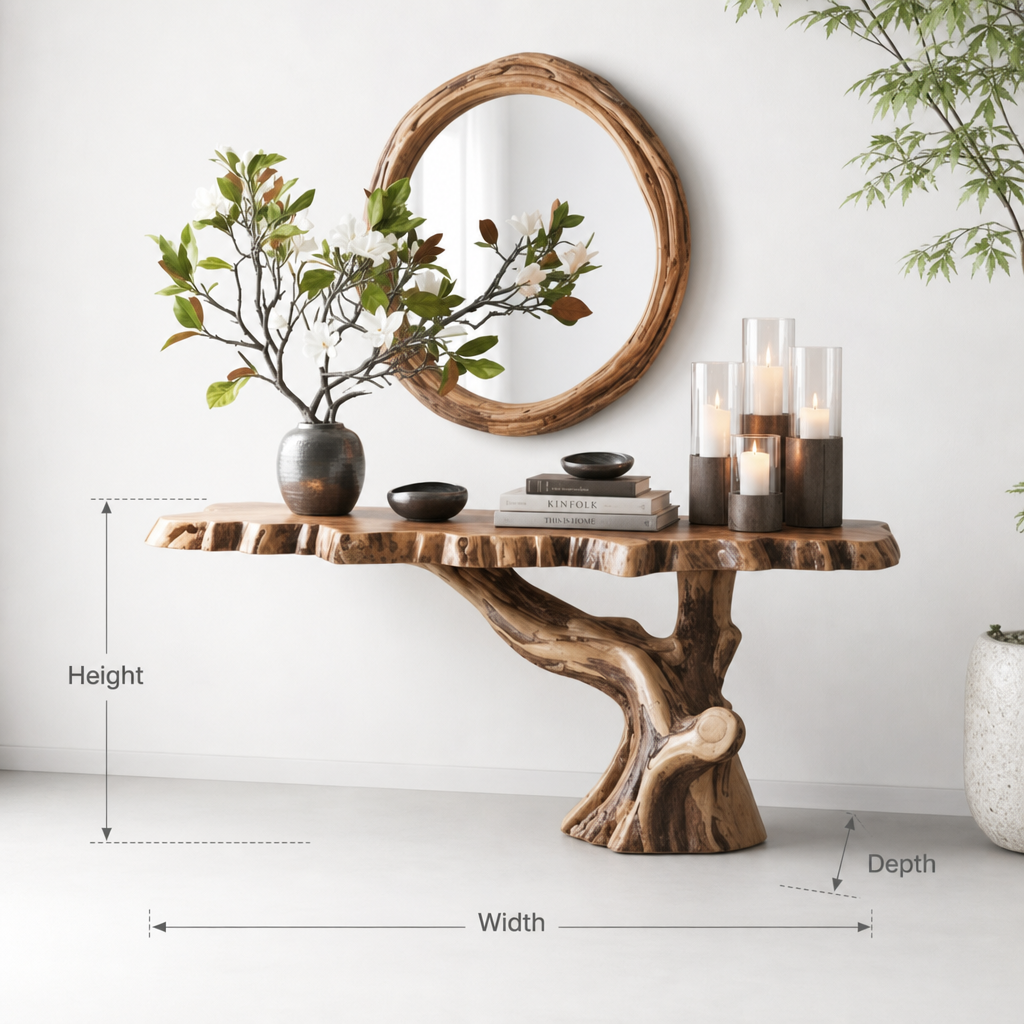
Farmhouse / rustic / organic modern: live edge, natural wood grain, organic shapes. Pieces like the Ashdeco Reclaimed Wood Console Table bring that raw, handcrafted warmth that makes a hallway feel like it has a soul. More on this style in our rustic console table guide.
Japandi / minimalist / contemporary: clean lines, open bases, lighter woods. The Curved Solid Wood Console Table with Drawer has a sculptural simplicity that reads as modern without feeling sterile.
Traditional / colonial / transitional: straight lines, darker stains, maybe a drawer or two for storage. Look for pieces with classic proportions and restrained detailing.
Eclectic / maximalist: mixed materials, sculptural bases, anything with character. The Unique Art Solid Wood Console Table is the kind of piece that makes guests stop mid-hallway and ask "where did you get that?"
Browse the full console table collection to see 120+ handcrafted pieces across all styles - each one solid wood, hand-carved by Vietnamese artisans, made to order.

Open vs. Storage Console: What Does Your Hallway Actually Need?
This is a real question, not a style preference. Most hallways don't need storage because they're transitional spaces - you're walking through, not living in them. But there are exceptions.
Go open if:
- Your hallway is narrow (open bases feel less visually heavy)
- You already have storage elsewhere (entryway cabinet, mudroom)
- You want the hallway to feel airy and light

Go storage if:
- This hallway is your only entry point - you need a spot for gloves, keys, dog leashes
- You're using the hallway as a quasi-mudroom (common in smaller homes and apartments)
- You want to hide things from view (umbrellas, pet supplies, mail you haven't sorted)

The compromise: one drawer + open shelf below. Gives you a catch-all for small items without turning the console into a cabinet. The curved console with drawer hits this balance nicely.
For a full comparison of open vs storage designs and which scenarios each one suits best, our console table storage vs open guide walks through the trade-offs.

A hallway table that actually looks like it belongs there.
The Rustic Tree Root Console Table brings a sculptural, one-of-a-kind live edge base to any hallway - handcrafted from solid wood, built to anchor a wall without crowding the walkway.
Shop Console Tables →Solid wood · Handcrafted · Made to order
Common Hallway Console Mistakes (And How to Avoid Them)
1. Buying Too Deep - The #1 Hallway Mistake
A standard console table runs 16–18 inches deep. That's fine behind a sofa or in a spacious entryway. In a 36-inch hallway, it leaves only 9 inches of clearance on each side. People will bump into it. Daily. And they'll resent the table every single time.
For hallways under 40 inches wide, stick to 10–14 inches of depth. The narrow vs standard depth comparison breaks down exactly when slim tables outperform full-depth ones.
2. Going Too Long
A console that nearly touches both end walls of the hallway feels squeezed, not styled. Leave at least 6–12 inches of bare wall on each side. This gives the table room to breathe and makes the hallway feel wider than it is.
3. Ignoring the Runner Rug
If you have (or plan to add) a runner rug, the console and rug need to work together. The rug should extend at least 6 inches past each end of the table. If the table is wider than the rug, it looks like the table is sitting on an island - not a cohesive design.
4. Wrong-Scale Artwork Above
Tiny art above a long console looks lost. Massive art above a short console overwhelms. Match the artwork width to roughly ⅔–¾ of the table width. If you want multiple pieces, a small gallery wall (2–3 frames) works as long as the total composition stays within that range.
5. Forgetting About Lighting
Most hallways don't have great overhead lighting. A small table lamp on the console adds ambient warmth that makes the whole corridor feel more inviting - and it gives the space a "finished" quality that nothing else can replicate. Battery-powered LED lamps are a great option if there's no outlet nearby.
Hallway Table vs. Other Empty Wall Solutions
A console table isn't the only way to deal with a blank hallway wall - it's just usually the best one. Here's when something else makes more sense.
Floating shelves instead of a console: under 30 inches of hallway width, a shallow floating shelf (6–8 inches deep) gives you the visual interest without eating into your walkway. You lose the surface area, but you get the clearance back.
A gallery wall instead of furniture: if you're renting, or the hallway barely has four feet of usable wall, a well-composed gallery wall can do the same visual job without adding any footprint at all.
Bench + console combo: common in homes where the garage opens straight into a hallway that doubles as a mudroom. A narrow bench with a console above gives you seating and surface in the same zone - just don't let the bench eat into your walking clearance.
The hallway trifecta: console table, mirror above, runner rug below. When these three work together, it's about as complete as this kind of space gets. It's the natural setup for entryways that flow straight into a hallway - our entryway console guide covers this combination in more detail.
And if what you're actually dealing with is the space behind a sofa in an open-plan living room rather than a true hallway, our guide to sizing a console behind your sofa covers that specific scenario.

Frequently Asked Questions About Hallway Console Tables
What size console table for a hallway?
Aim for ½ to ⅔ of the available wall length, 10–14 inches deep, and 30–34 inches tall. For an 8-foot wall, that's roughly 48–64 inches long. Wider hallways (40+ inches) give you room to go 14–16 inches deep without crowding the walkway.
How much clearance does a hallway console table need?
At least 14–18 inches between the table's front edge and whatever's on the opposite side - a wall, or other furniture. In high-traffic hallways, push that up to 18–24 inches if you can.
Can you put a console table in a narrow hallway?
Yes, as long as the hallway is at least 30 inches wide and the table is 10 inches deep or less - that combination still leaves 20 inches of clearance, which works. Below 30 inches of width, a floating shelf is the better call.
What do you put on a hallway console table?
Keep it to three things: a lamp for ambient light, one object - a small plant, something sculptural - and a tray for keys if the hallway sits near your entry. Hallways aren't storage surfaces, so resist the urge to pile more on.
Should a hallway console table match the entryway table?
Same wood warmth family, not an exact match. Warm walnut entry table, warm oak hallway console - that works fine. A cool grey-washed piece next to it will feel like it belongs to a different house. Cohesion, not matching.
Ready to Fill That Empty Hallway?
Whether you need a slim 10-inch console for a tight corridor or a statement live-edge piece for a wide entry hall, Ashdeco's console table collection has 120+ handcrafted solid wood options - each made to order by Vietnamese artisans from sustainably sourced hardwood, joined the way furniture used to be joined, not glued together and hoped for the best.
Use code ASHDECO5 at checkout for 5% off your order. Free shipping on all console tables.